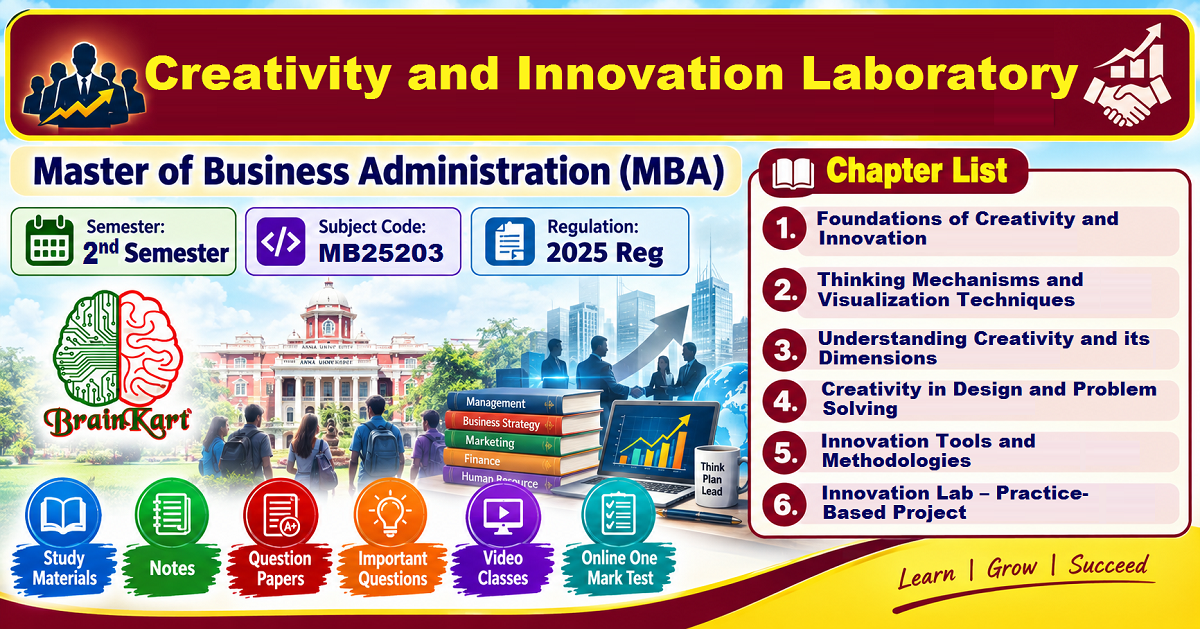
Creativity and Innovation Laboratory - MB25203
[ 2nd Semester - MBA - Master of Business Administration ]
Under Class: | 2nd Semester [MBA Dept Anna University 2025 Regulation] |
Creativity and Innovation Laboratory - MB25203 - Practical Manual, Experiments, Guide Study Materials PDF Download
Mba - Creativity and Innovation Laboratory - MB25203 Subject (under Anna University 2nd Semester - MBA - Master of Business Administration Regulation 2025) - Practical Manual, Experiments, Guide Study Materials PDF Download
MB25203:
Creativity
and Innovation Laboratory
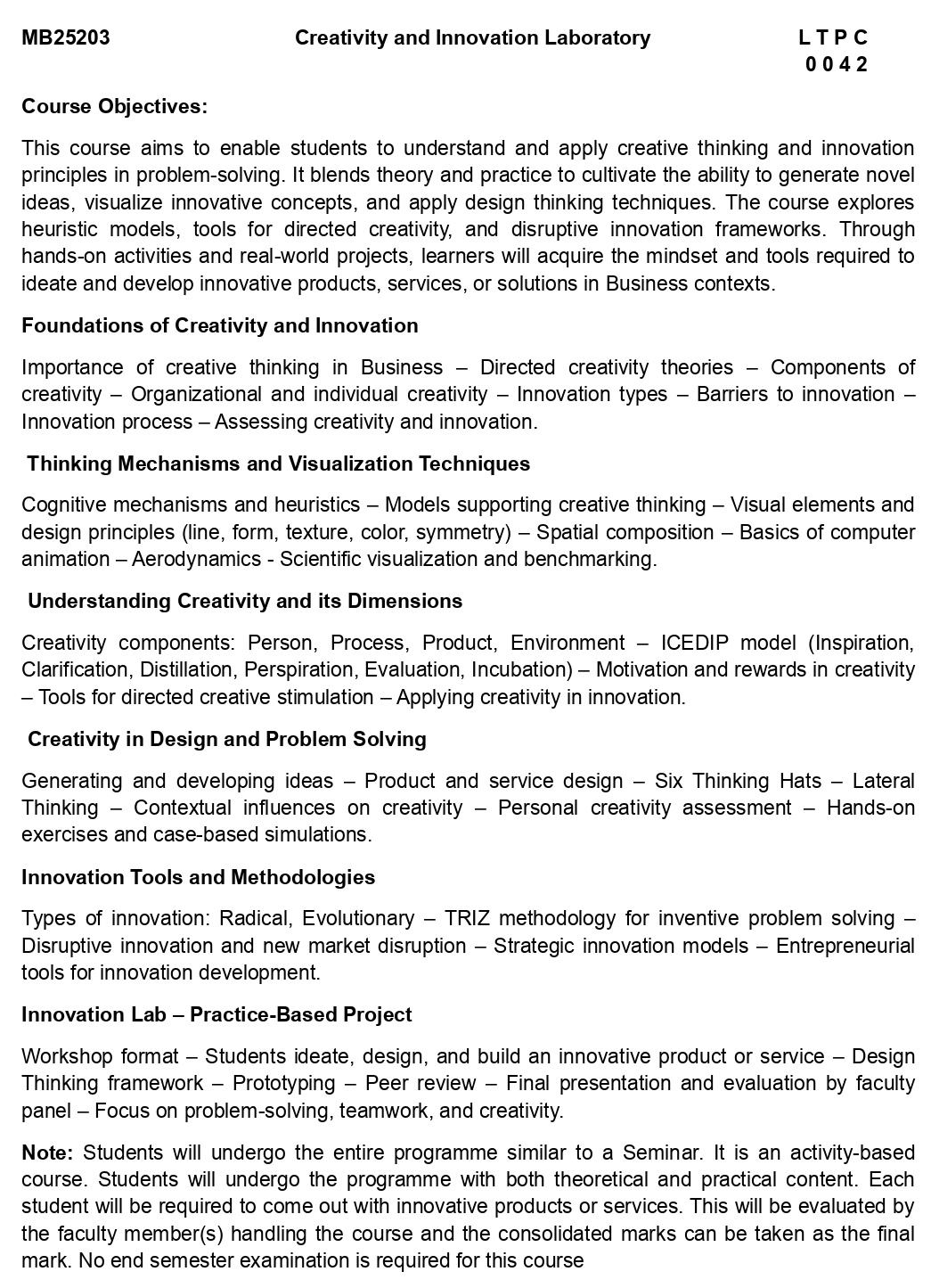
Course Objectives:
This
course aims to enable students to understand and apply creative thinking and
innovation principles in problem-solving. It blends theory and practice to
cultivate the ability to generate novel ideas, visualize innovative concepts,
and apply design thinking techniques. The course explores heuristic models,
tools for directed creativity, and disruptive innovation frameworks. Through
hands-on activities and real-world projects, learners will acquire the mindset
and tools required to ideate and develop innovative products, services, or
solutions in Business contexts.
Foundations
of Creativity and Innovation
Importance
of creative thinking in Business – Directed creativity theories – Components of
creativity – Organizational and individual creativity – Innovation types –
Barriers to innovation – Innovation process – Assessing creativity and
innovation.
Thinking
Mechanisms and Visualization Techniques
Cognitive
mechanisms and heuristics – Models supporting creative thinking – Visual
elements and design principles (line, form, texture, color, symmetry) – Spatial
composition – Basics of computer animation – Aerodynamics - Scientific
visualization and benchmarking.
Understanding
Creativity and its Dimensions
Creativity
components: Person, Process, Product, Environment – ICEDIP model (Inspiration,
Clarification, Distillation, Perspiration, Evaluation, Incubation) – Motivation
and rewards in creativity – Tools for directed creative stimulation – Applying
creativity in innovation.
Creativity
in Design and Problem Solving
Generating
and developing ideas – Product and service design – Six Thinking Hats – Lateral
Thinking – Contextual influences on creativity – Personal creativity assessment
– Hands-on exercises and case-based simulations.
Innovation
Tools and Methodologies
Types
of innovation: Radical, Evolutionary – TRIZ methodology for inventive problem
solving – Disruptive innovation and new market disruption – Strategic
innovation models – Entrepreneurial tools for innovation development.
Innovation
Lab – Practice-Based Project
Workshop
format – Students ideate, design, and build an innovative product or service –
Design Thinking framework – Prototyping – Peer review – Final presentation and
evaluation by faculty panel – Focus on problem-solving, teamwork, and
creativity.
Note:
Students will undergo the entire programme similar to a Seminar. It is an
activity-based course. Students will undergo the programme with both
theoretical and practical content. Each student will be required to come out
with innovative products or services. This will be evaluated by the faculty
member(s) handling the course and the consolidated marks can be taken as the
final mark. No end semester examination is required for this course
References:
1.
Floyd Hurt, Rousing Creativity: Think New Now, Crisp Publications,
2.
Geoffrey Petty, How to Be Better at Creativity, Industrial Society, 2012
3.
Clayton Christensen & Michael Raynor, The Innovator’s Solution, Harvard
Business School Press, 2024
4.
Semyon D. Savransky, Engineering of Creativity – TRIZ, CRC Press, 2000
5.
C. S. G. Krishnamacharyulu & Lalitha R., Innovation Management, Himalaya
Publishing House, 2013
6.
Jeanne Liedtka, Design Thinking for the Greater Good, Columbia Business School
Publishing, 2017
7.
Edward de Bono, Six Thinking Hats, Penguin (Little, Brown & Company)
Course
Outcomes
After successful completion of this course, students will be able to:
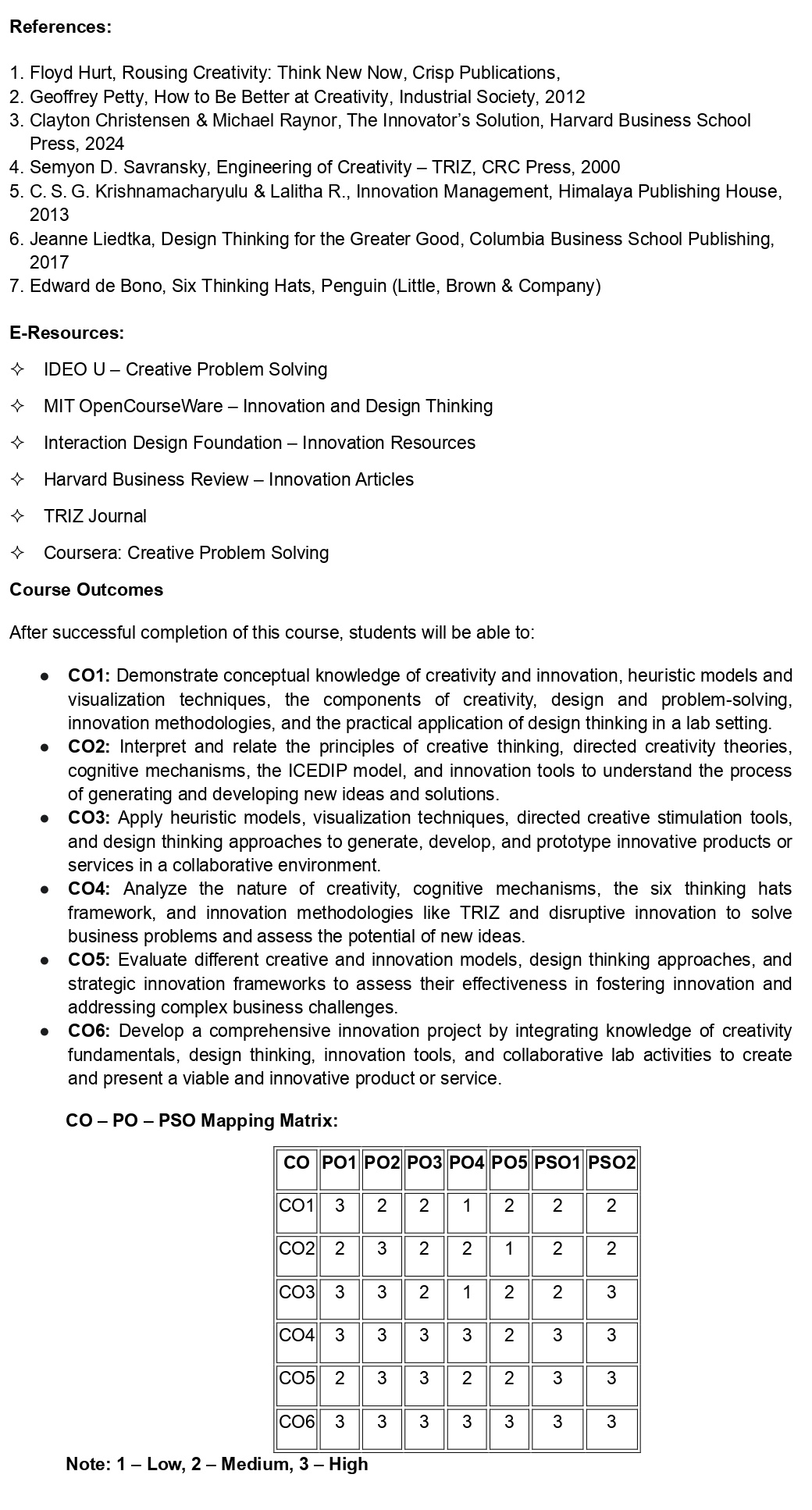
● CO1:
Demonstrate conceptual knowledge of creativity and innovation, heuristic models
and visualization techniques, the components of creativity, design and
problem-solving, innovation methodologies, and the practical application of
design thinking in a lab setting.
● CO2:
Interpret and relate the principles of creative thinking, directed creativity
theories, cognitive mechanisms, the ICEDIP model, and innovation tools to
understand the process of generating and developing new ideas and solutions.
●
CO3: Apply heuristic models,
visualization techniques, directed creative stimulation tools, and design
thinking approaches to generate, develop, and prototype innovative products or
services in a collaborative environment.
● CO4:
Analyze the nature of creativity, cognitive mechanisms, the six thinking hats
framework, and innovation methodologies like TRIZ and disruptive innovation to
solve business problems and assess the potential of new ideas.
● CO5:
Evaluate different creative and innovation models, design thinking approaches,
and strategic innovation frameworks to assess their effectiveness in fostering
innovation and addressing complex business challenges.
● CO6:
Develop a comprehensive innovation project by integrating knowledge of
creativity fundamentals, design thinking, innovation tools, and collaborative
lab activities to create and present a viable and innovative product or
service.