Control Systems - EE25C07
[ 4th Semester - EEE - Electrical and Electronics Engineering Department ]
Under Class: | 4th Semester [EEE Dept Anna University 2025 Regulation] |
Control Systems - EE25C07 - Study Materials, Notes, Important Questions, Anna University Semester Question Paper PDF Download
Engineering - Control Systems - EE25C07 Subject (under Anna University 4th Semester - EEE - Electrical and Electronics Engineering Department Regulation 2025) - Study Materials, Written and lecture Notes, Important Questions, Semester Question Paper PDF Download
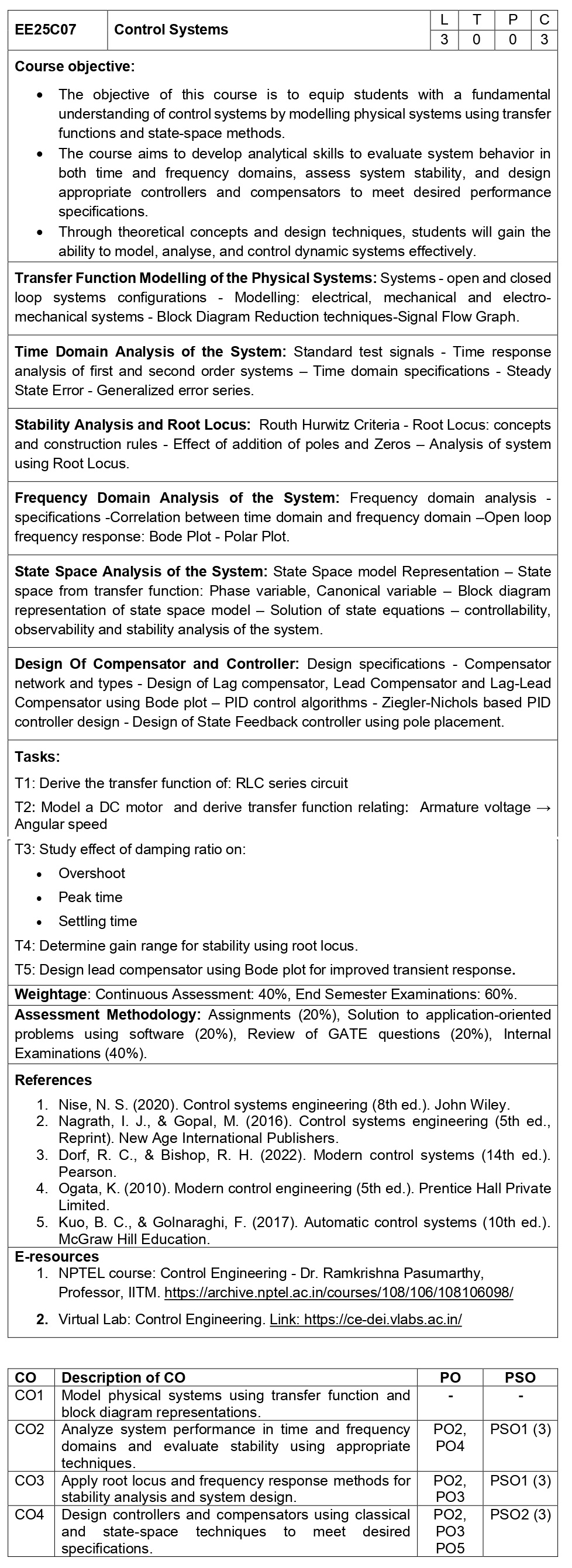
EE25C07:
Control
Systems
Course
objective:
•
The objective of this course is to equip students with a fundamental
understanding of control systems by modelling physical systems using transfer
functions and state-space methods.
•
The course aims to develop analytical skills to evaluate system behavior in
both time and frequency domains, assess system stability, and design
appropriate controllers and compensators to meet desired performance
specifications.
•
Through theoretical concepts and design techniques, students will gain the ability
to model, analyse, and control dynamic systems effectively.
Transfer
Function Modelling of the Physical Systems:
Systems - open and closed loop systems configurations - Modelling: electrical,
mechanical and electro-mechanical systems - Block Diagram Reduction
techniques-Signal Flow Graph.
Time
Domain Analysis of the System: Standard test signals
- Time response analysis of first and second order systems – Time domain
specifications - Steady State Error - Generalized error series.
Stability
Analysis and Root Locus: Routh Hurwitz Criteria
- Root Locus: concepts and construction rules - Effect of addition of poles and
Zeros – Analysis of system using Root Locus.
Frequency
Domain Analysis of the System: Frequency domain
analysis - specifications -Correlation between time domain and frequency domain
–Open loop frequency response: Bode Plot - Polar Plot.
State
Space Analysis of the System: State Space model
Representation – State space from transfer function: Phase variable, Canonical
variable – Block diagram representation of state space model – Solution of
state equations – controllability, observability and stability analysis of the
system.
Design Of
Compensator and Controller: Design specifications
- Compensator network and types - Design of Lag compensator, Lead Compensator
and Lag-Lead Compensator using Bode plot – PID control algorithms -
Ziegler-Nichols based PID controller design - Design of State Feedback
controller using pole placement.
Tasks:
T1:
Derive the transfer function of: RLC series circuit
T2:
Model a DC motor and derive transfer function relating: Armature voltage →
Angular speed
T3:
Study effect of damping ratio on:
•
Overshoot
•
Peak time
•
Settling time
T4:
Determine gain range for stability using root locus.
T5:
Design lead compensator using Bode plot for improved transient response.
Weightage:
Continuous Assessment: 40%, End Semester Examinations: 60%.
Assessment Methodology:
Assignments (20%), Solution to application-oriented
problems
using software (20%), Review of GATE questions (20%), Internal Examinations
(40%).
References
1.
Nise, N. S. (2020). Control systems engineering (8th ed.). John Wiley.
2.
Nagrath, I. J., & Gopal, M. (2016). Control systems engineering (5th ed.,
Reprint). New Age International Publishers.
3.
Dorf, R. C., & Bishop, R. H. (2022). Modern control systems (14th ed.).
Pearson.
4.
Ogata, K. (2010). Modern control engineering (5th ed.). Prentice Hall Private
Limited.
5.
Kuo, B. C., & Golnaraghi, F. (2017). Automatic control systems (10th ed.).
McGraw Hill Education.