Concrete Technology - CE25C06
[ 4th Semester - Civil Engineering Department ]
Under Class: | 4th Semester [Civil Dept Anna University 2025 Regulation] |
Concrete Technology - CE25C06 - Study Materials, Notes, Important Questions, Anna University Semester Question Paper PDF Download
Engineering - Concrete Technology - CE25C06 Subject (under Anna University 4th Semester - Civil Engineering Department Regulation 2025) - Study Materials, Written and lecture Notes, Important Questions, Semester Question Paper PDF Download
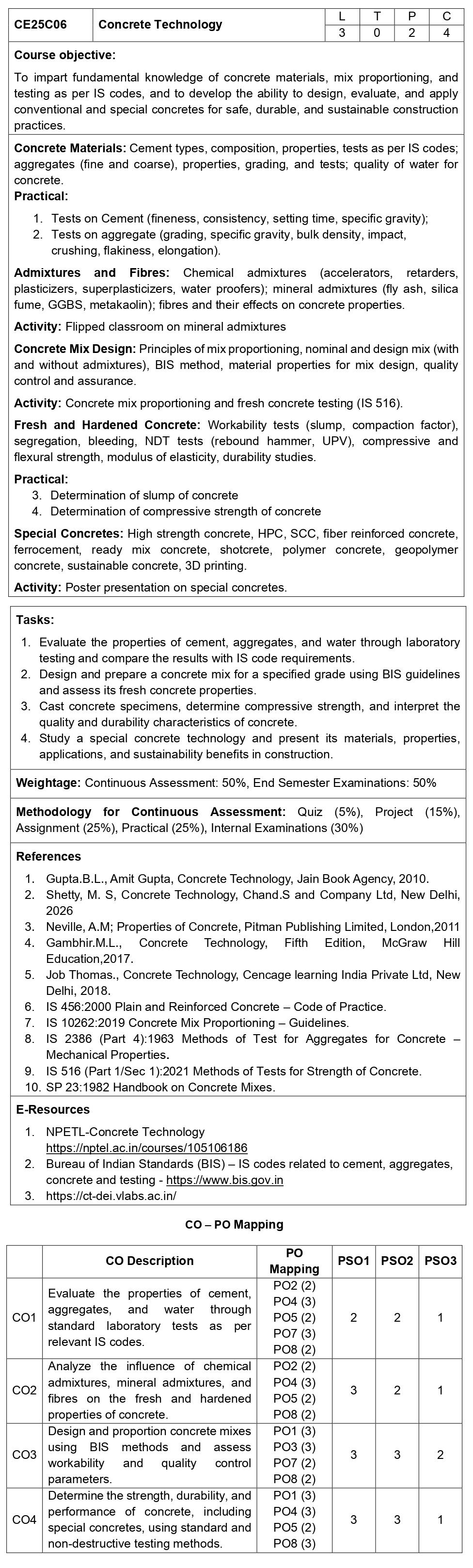
CE25C06:
Concrete
Technology
Course
objective:
To
impart fundamental knowledge of concrete materials, mix proportioning, and
testing as per IS codes, and to develop the ability to design, evaluate, and
apply conventional and special concretes for safe, durable, and sustainable
construction
practices.
Concrete
Materials: Cement types, composition, properties,
tests as per IS codes; aggregates (fine and coarse), properties, grading, and
tests; quality of water for concrete.
Practical:
1.
Tests on Cement (fineness, consistency, setting time, specific gravity);
2.
Tests on aggregate (grading, specific gravity, bulk density, impact, crushing,
flakiness, elongation).
Admixtures
and Fibres: Chemical admixtures (accelerators,
retarders, plasticizers, superplasticizers, water proofers); mineral admixtures
(fly ash, silica fume, GGBS, metakaolin); fibres and their effects on concrete
properties.
Activity:
Flipped classroom on mineral admixtures
Concrete
Mix Design: Principles of mix proportioning, nominal
and design mix (with and without admixtures), BIS method, material properties
for mix design, quality control and assurance.
Activity:
Concrete mix proportioning and fresh concrete testing (IS 516).
Fresh and
Hardened Concrete: Workability tests (slump,
compaction factor), segregation, bleeding, NDT tests (rebound hammer, UPV),
compressive and flexural strength, modulus of elasticity, durability studies.
Practical:
3.
Determination of slump of concrete
4.
Determination of compressive strength of concrete
Special
Concretes: High strength concrete, HPC, SCC, fiber
reinforced concrete, ferrocement, ready mix concrete, shotcrete, polymer
concrete, geopolymer concrete, sustainable concrete, 3D printing.
Activity:
Poster presentation on special concretes.
Tasks:
1.
Evaluate the properties of cement, aggregates, and water through laboratory
testing and compare the results with IS code requirements.
2.
Design and prepare a concrete mix for a specified grade using BIS guidelines
and assess its fresh concrete properties.
3.
Cast concrete specimens, determine compressive strength, and interpret the
quality and durability characteristics of concrete.
4.
Study a special concrete technology and present its materials, properties,
applications, and sustainability benefits in construction.
Weightage:
Continuous Assessment: 50%, End Semester Examinations: 50%
Methodology for
Continuous Assessment: Quiz(5%),Project(15%), Assignment
(25%), Practical (25%), Internal Examinations (30%)
References
1.
Gupta.B.L., Amit Gupta, Concrete Technology, Jain Book Agency, 2010.
2.
Shetty, M. S, Concrete Technology, Chand.S and Company Ltd, New Delhi, 2026
3.
Neville, A.M; Properties of Concrete, Pitman Publishing Limited, London,2011
4.
Gambhir.M.L., Concrete Technology,FifthEdition,McGrawHill Education,2017.
5.
Job Thomas., Concrete Technology, Cencage learning India Private Ltd, New
Delhi, 2018.
6.
IS 456:2000 Plain and Reinforced Concrete – Code of Practice.
7.
IS 10262:2019 Concrete Mix Proportioning – Guidelines.
8.
IS 2386 (Part 4):1963 Methods of Test for Aggregates for Concrete – Mechanical
Properties.
9.
IS 516 (Part 1/Sec 1):2021 Methods of Tests for Strength of Concrete.
10.
SP 23:1982 Handbook on Concrete Mixes.