Computer Programming: Python - CS25C02
[ 1st Semester - MECH,CIVIL,AGRI Departments ]
Under Class: | 1st Semester [Mechanical Dept Anna University 2025 Regulation] | | 1st Semester [Civil Dept Anna University 2025 Regulation] | | 1st Semester [Agricultural Dept Anna University 2025 Regulation] |
Computer Programming: Python - CS25C02 - Study Materials, Notes, Important Questions, Anna University Semester Question Paper PDF Download
Engineering - Computer Programming: Python - CS25C02 Subject (under Anna University 1st Semester - Engineering Regulation 2025) - Study Materials, Written and lecture Notes, Important Questions, Semester Question Paper PDF Download
CS25C02
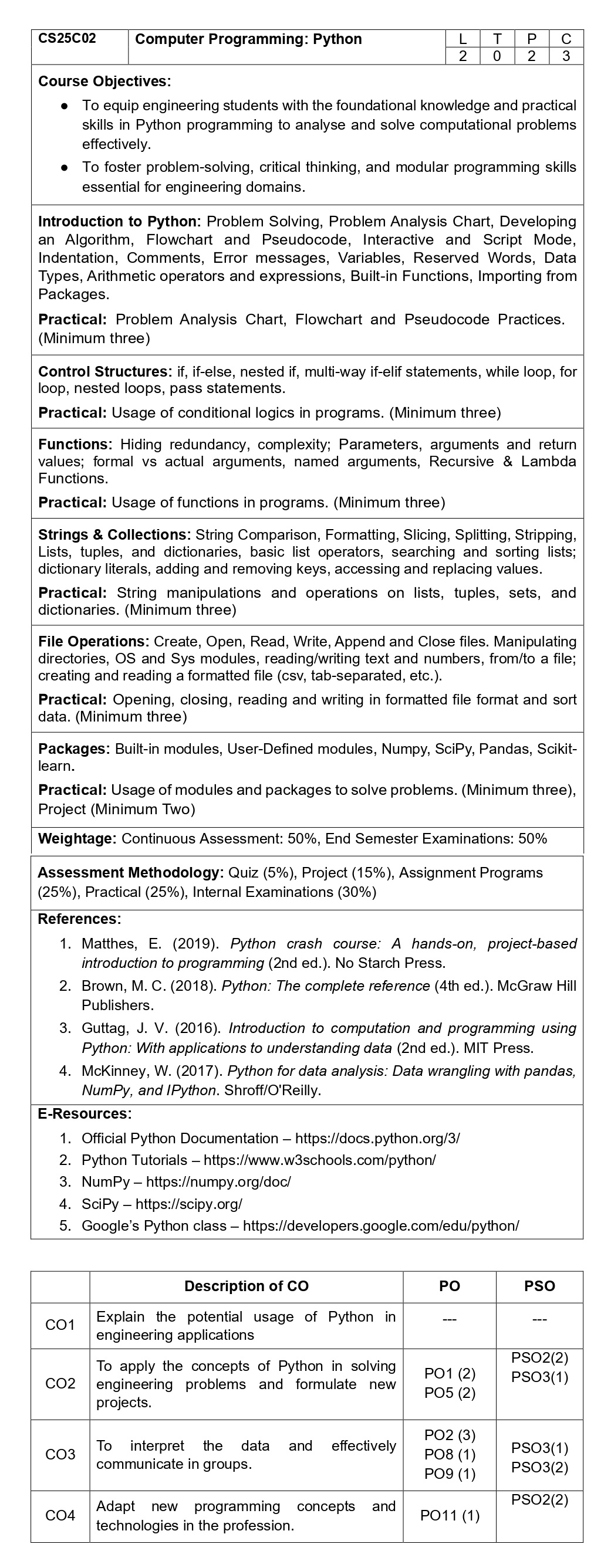
CS25C02 :
Computer Programming : Python
Course
Objectives:
●
To equip engineering students with the foundational knowledge and practical
skills in Python programming to analyse and solve computational problems effectively.
●
To foster problem-solving, critical thinking, and modular programming skills
essential for engineering domains.
Introduction
to Python: Problem Solving, Problem Analysis
Chart, Developing an Algorithm, Flowchart and Pseudocode, Interactive and
Script Mode, Indentation, Comments, Error messages, Variables, Reserved Words,
Data Types, Arithmetic operators and expressions, Built-in Functions, Importing
from Packages.
Practical:
Problem Analysis Chart, Flowchart and Pseudocode Practices. (Minimum three)
Control
Structures: if, if-else, nested if, multi-way
if-elif statements, while loop, for loop, nested loops, pass statements.
Practical:
Usage of conditional logics in programs. (Minimum three)
Functions:
Hiding redundancy, complexity; Parameters, arguments and return values; formal
vs actual arguments, named arguments, Recursive & Lambda Functions.
Practical:
Usage of functions in programs. (Minimum three)
Strings
& Collections: String Comparison, Formatting,
Slicing, Splitting, Stripping, Lists, tuples, and dictionaries, basic list
operators, searching and sorting lists; dictionary literals, adding and
removing keys, accessing and replacing values.
Practical:
String manipulations and operations on lists, tuples, sets, and dictionaries.
(Minimum three)
File
Operations: Create, Open, Read, Write, Append and
Close files. Manipulating directories, OS and Sys modules, reading/writing text
and numbers, from/to a file; creating and reading a formatted file (csv,
tab-separated, etc.).
Practical:
Opening, closing, reading and writing in formatted file format and sort data.
(Minimum three)
Packages:
Built-in modules, User-Defined modules, Numpy, SciPy, Pandas, Scikit-learn.
Practical:
Usage of modules and packages to solve problems. (Minimum three), Project
(Minimum Two)
Weightage:
Continuous Assessment: 50%, End Semester Examinations: 50%
Methodology for
Continuous Assessment: Quiz (5%), Project (15%),
Assignment Programs (25%), Practical (25%), Internal Examinations (30%)
References:
1.Matthes,
E. (2019). Python crash course: A hands-on, project-based introduction to
programming . No Starch Press.
2.Brown,
M. C. (2018). Python: The complete reference. McGraw Hill Publishers.
3.Guttag,
J. V. (2016). Introduction to computation and programming using Python: With
applications to understanding data. MIT Press.
4.McKinney,
W. (2017). Python for data analysis: Data wrangling with pandas, NumPy, and
IPython. Shroff/O'Reilly.
E-Resources:
1.
Official Python Documentation – https://docs.python.org/3/
2.
Python Tutorials – https://www.w3schools.com/python/
3.
NumPy – https://numpy.org/doc/
4.
SciPy – https://scipy.org/
5.
Google’s Python class – https://developers.google.com/edu/python/