Computer Organization and Architecture - CW25201
[ 3rd Semester - IT - Information Technology Department ]
Under Class: | 3rd Semester [IT Dept Anna University 2025 Regulation] |
Computer Organization and Architecture - CW25201 - Study Materials, Notes, Important Questions, Anna University Semester Question Paper PDF Download
Engineering - Computer Organization and Architecture - CW25201 Subject (under Anna University 3rd Semester - IT - Information Technology Department Regulation 2025) - Study Materials, Written and lecture Notes, Important Questions, Semester Question Paper PDF Download
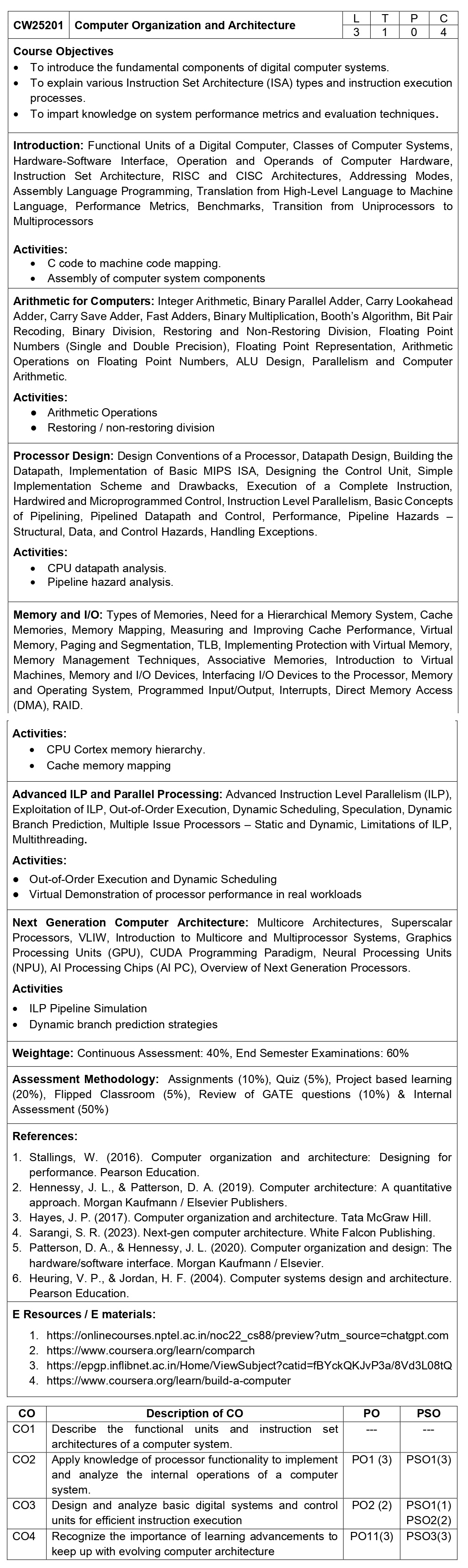
CW25201:
Computer
Organization and Architecture
Course
Objectives
•
To introduce the fundamental components of digital computer systems.
•
To explain various Instruction Set Architecture (ISA) types and instruction
execution processes.
•
To impart knowledge on system performance metrics and evaluation techniques.
Introduction:
Functional Units of a Digital Computer, Classes of Computer Systems,
Hardware-Software Interface, Operation and Operands of Computer Hardware,
Instruction Set Architecture, RISC and CISC Architectures, Addressing Modes,
Assembly Language Programming, Translation from High-Level Language to Machine
Language, Performance Metrics, Benchmarks, Transition from Uniprocessors to
Multiprocessors
Activities:
•
C code to machine code mapping.
•
Assembly of computer system components
Arithmetic
for Computers: Integer Arithmetic, Binary Parallel
Adder, Carry Lookahead Adder, Carry Save Adder, Fast Adders, Binary
Multiplication, Booth’s Algorithm, Bit Pair Recoding, Binary Division,
Restoring and Non-Restoring Division, Floating Point Numbers (Single and Double
Precision), Floating Point Representation, Arithmetic Operations on Floating
Point Numbers, ALU Design, Parallelism and Computer Arithmetic.
Activities:
•
Arithmetic Operations
•
Restoring / non-restoring division
Processor
Design: Design Conventions of a Processor,
Datapath Design, Building the Datapath, Implementation of Basic MIPS ISA,
Designing the Control Unit, Simple Implementation Scheme and Drawbacks,
Execution of a Complete Instruction, Hardwired and Microprogrammed Control,
Instruction Level Parallelism, Basic Concepts of Pipelining, Pipelined Datapath
and Control, Performance, Pipeline Hazards – Structural, Data, and Control
Hazards, Handling Exceptions.
Activities:
•
CPU datapath analysis.
•
Pipeline hazard analysis.
Memory
and I/O: Types of Memories, Need for a
Hierarchical Memory System, Cache Memories, Memory Mapping, Measuring and
Improving Cache Performance, Virtual Memory, Paging and Segmentation, TLB,
Implementing Protection with Virtual Memory, Memory Management Techniques,
Associative Memories, Introduction to Virtual Machines, Memory and I/O Devices,
Interfacing I/O Devices to the Processor, Memory and Operating System,
Programmed Input/Output, Interrupts, Direct Memory Access (DMA), RAID.
Activities:
•
CPU Cortex memory hierarchy.
•
Cache memory mapping
Advanced
ILP and Parallel Processing: Advanced Instruction
Level Parallelism (ILP), Exploitation of ILP, Out-of-Order Execution, Dynamic
Scheduling, Speculation, Dynamic Branch Prediction, Multiple Issue Processors –
Static and Dynamic, Limitations of ILP, Multithreading.
Activities:
•
Out-of-Order Execution and Dynamic Scheduling
•
Virtual Demonstration of processor performance in real workloads
Next
Generation Computer Architecture: Multicore
Architectures, Superscalar Processors, VLIW, Introduction to Multicore and
Multiprocessor Systems, Graphics Processing Units (GPU), CUDA Programming
Paradigm, Neural Processing Units (NPU), AI Processing Chips (AI PC), Overview
of Next Generation Processors.
Activities
•
ILP Pipeline Simulation
•
Dynamic branch prediction strategies
Weightage:
Continuous Assessment: 40%, End Semester Examinations: 60%
Assessment Methodology:
Assignments (10%), Quiz (5%), Project based learning (20%), Flipped Classroom
(5%), Review of GATE questions (10%) & Internal Assessment (50%)
References:
1.
Stallings, W. (2016). Computer organization and architecture: Designing for
performance. Pearson Education.
2.
Hennessy, J. L., & Patterson, D. A. (2019). Computer architecture: A
quantitative approach. Morgan Kaufmann / Elsevier Publishers.
3.
Hayes, J. P. (2017). Computer organization and architecture. Tata McGraw Hill.
4.
Sarangi, S. R. (2023). Next-gen computer architecture. White Falcon Publishing.
5.
Patterson, D. A., & Hennessy, J. L. (2020). Computer organization and
design: The hardware/software interface. Morgan Kaufmann / Elsevier.
6.
Heuring, V. P., & Jordan, H. F. (2004). Computer systems design and
architecture.
Pearson
Education.