Capstone Simulation - MB25302
[ 3rd Semester - MBA - Master of Business Administration ]
Under Class: | 3rd Semester [MBA Dept Anna University 2025 Regulation] |
Capstone Simulation - MB25302 - Practical Manual, Experiments, Guide Study Materials PDF Download
Mba - Capstone Simulation - MB25302 Subject (under Anna University 3rd Semester - MBA - Master of Business Administration Regulation 2025) - Practical Manual, Experiments, Guide Study Materials PDF Download
MB25302:
Capstone
Simulation - Laboratory
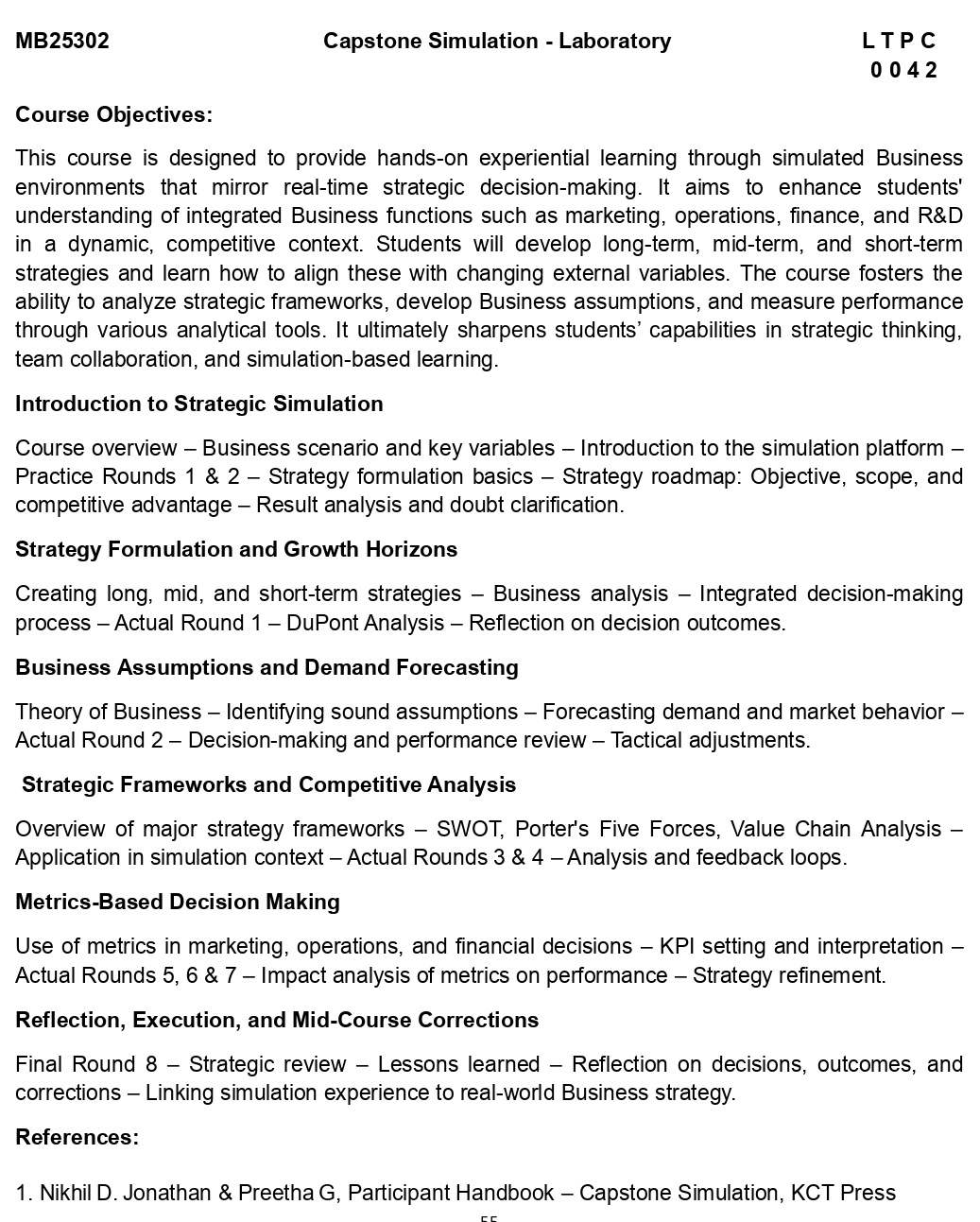
Course Objectives:
This
course is designed to provide hands-on experiential learning through simulated
Business environments that mirror real-time strategic decision-making. It aims
to enhance students' understanding of integrated Business functions such as
marketing, operations, finance, and R&D in a dynamic, competitive context.
Students will develop long-term, mid-term, and short-term strategies and learn
how to align these with changing external variables. The course fosters the
ability to analyze strategic frameworks, develop Business assumptions, and
measure performance through various analytical tools. It ultimately sharpens
students’ capabilities in strategic thinking, team collaboration, and
simulation-based learning.
Introduction
to Strategic Simulation
Course
overview – Business scenario and key variables – Introduction to the simulation
platform – Practice Rounds 1 & 2 – Strategy formulation basics – Strategy
roadmap: Objective, scope, and competitive advantage – Result analysis and
doubt clarification.
Strategy
Formulation and Growth Horizons
Creating
long, mid, and short-term strategies – Business analysis – Integrated
decision-making process – Actual Round 1 – DuPont Analysis – Reflection on
decision outcomes.
Business
Assumptions and Demand Forecasting
Theory
of Business – Identifying sound assumptions – Forecasting demand and market
behavior – Actual Round 2 – Decision-making and performance review – Tactical
adjustments.
Strategic
Frameworks and Competitive Analysis
Overview
of major strategy frameworks – SWOT, Porter's Five Forces, Value Chain Analysis
– Application in simulation context – Actual Rounds 3 & 4 – Analysis and
feedback loops.
Metrics-Based
Decision Making
Use
of metrics in marketing, operations, and financial decisions – KPI setting and
interpretation – Actual Rounds 5, 6 & 7 – Impact analysis of metrics on performance
– Strategy refinement.
Reflection,
Execution, and Mid-Course Corrections
Final
Round 8 – Strategic review – Lessons learned – Reflection on decisions,
outcomes, and corrections – Linking simulation experience to real-world
Business strategy.
References:
1.
Nikhil D. Jonathan & Preetha G, Participant Handbook – Capstone Simulation,
KCT Press
2.
Henry Mintzberg, Bruce Ahlstrand & Joseph Lampel, Strategy Safari, Pearson
Education, 2nd Edition, 2020
3.
A. A. Thompson, Margaret Peteraf, John E. Gamble & A. J. Strickland III,
Crafting and Executing Strategy, McGraw Hill, 23rd Edition,2022
4.
Harvard Business Review Articles on Business Simulation and Strategic Thinking
— not a single book, but articles frequently updated.
5.
Pankaj Ghemawat, Commitment: The Dynamic of Strategy, Free Press
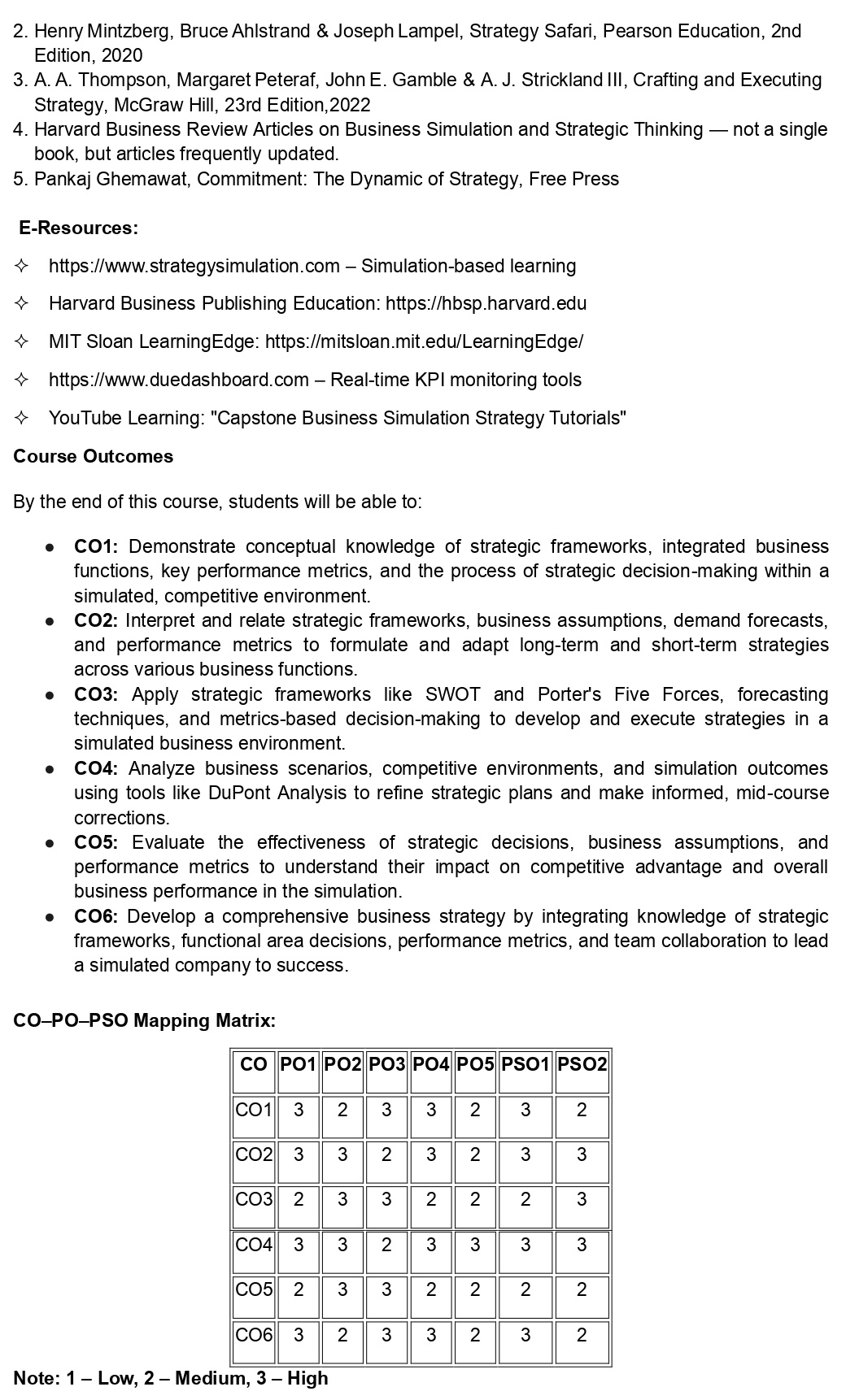
Course
Outcomes
By the end of this course, students will be able to:
● CO1:
Demonstrate conceptual knowledge of strategic frameworks, integrated business
functions, key performance metrics, and the process of strategic
decision-making within a simulated, competitive environment.
● CO2:
Interpret and relate strategic frameworks, business assumptions, demand
forecasts, and performance metrics to formulate and adapt long-term and
short-term strategies across various business functions.
● CO3:
Apply strategic frameworks like SWOT and Porter's Five Forces, forecasting
techniques, and metrics-based decision-making to develop and execute strategies
in a simulated business environment.
● CO4:
Analyze business scenarios, competitive environments, and simulation outcomes
using tools like DuPont Analysis to refine strategic plans and make informed,
mid-course corrections.
● CO5:
Evaluate the effectiveness of strategic decisions, business assumptions, and
performance metrics to understand their impact on competitive advantage and
overall business performance in the simulation.
● CO6:
Develop a comprehensive business strategy by integrating knowledge of strategic
frameworks, functional area decisions, performance metrics, and team collaboration
to lead a simulated company to success.