Business Research Methods - MB25C08
[ 2nd Semester - MBA - Master of Business Administration ]
Under Class: | 2nd Semester [MBA Dept Anna University 2025 Regulation] |
Business Research Methods - MB25C08 - Study Materials, Notes, Important Questions, Anna University Semester Question Paper PDF Download
Mba - Business Research Methods - MB25C08 Subject (under Anna University 2nd Semester - MBA - Master of Business Administration Regulation 2025) - Study Materials, Written and lecture Notes, Important Questions, Semester Question Paper PDF Download
MB25C08:
Business
Research Methods
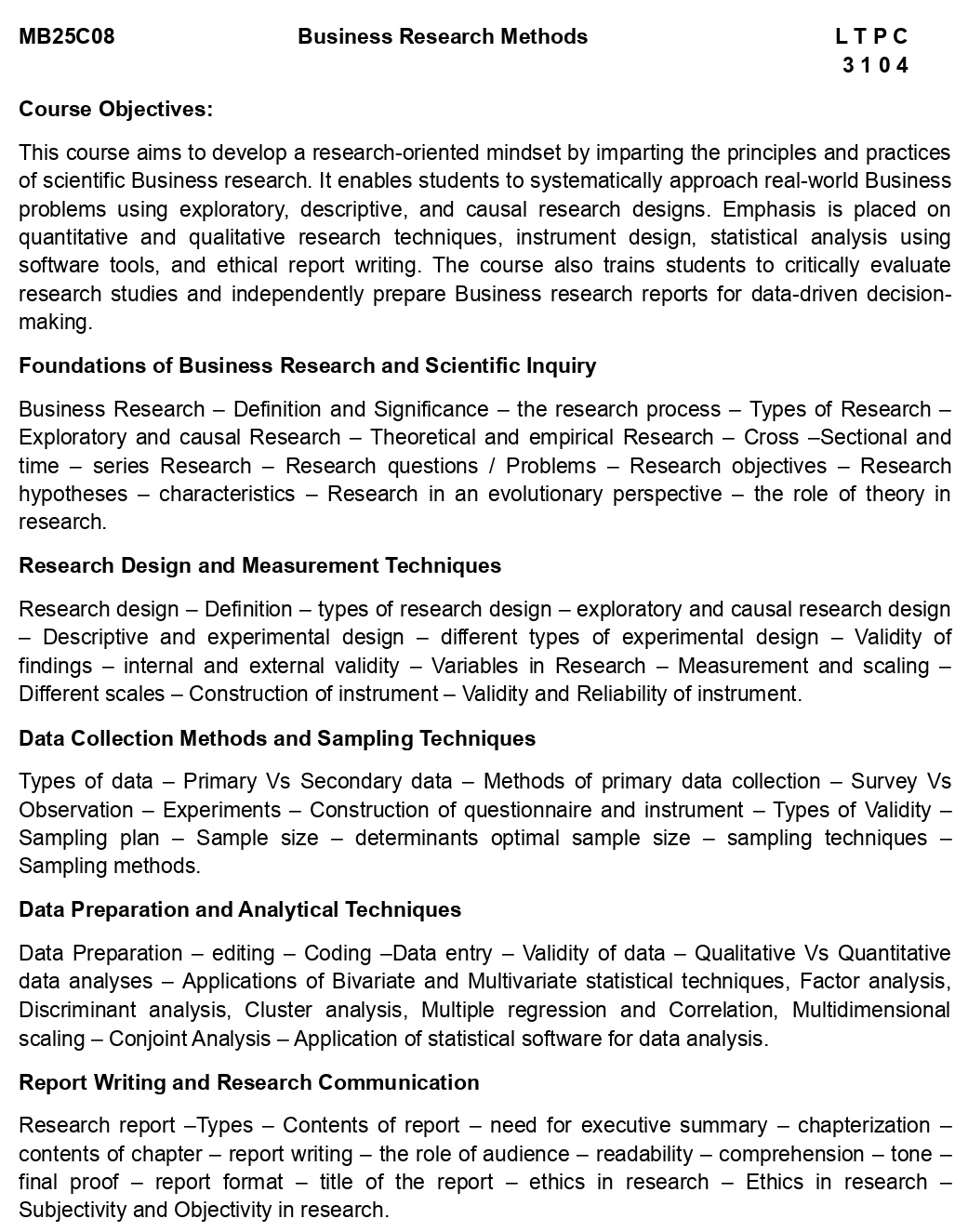
Course Objectives:
This
course aims to develop a research-oriented mindset by imparting the principles
and practices of scientific Business research. It enables students to
systematically approach real-world Business problems using exploratory,
descriptive, and causal research designs. Emphasis is placed on quantitative
and qualitative research techniques, instrument design, statistical analysis
using software tools, and ethical report writing. The course also trains
students to critically evaluate research studies and independently prepare Business
research reports for data-driven decision-making.
Foundations
of Business Research and Scientific Inquiry
Business
Research – Definition and Significance – the research process – Types of
Research – Exploratory and causal Research – Theoretical and empirical Research
– Cross –Sectional and time – series Research – Research questions / Problems –
Research objectives – Research hypotheses – characteristics – Research in an
evolutionary perspective – the role of theory in research.
Research
Design and Measurement Techniques
Research
design – Definition – types of research design – exploratory and causal
research design – Descriptive and experimental design – different types of
experimental design – Validity of findings – internal and external validity –
Variables in Research – Measurement and scaling – Different scales –
Construction of instrument – Validity and Reliability of instrument.
Data
Collection Methods and Sampling Techniques
Types
of data – Primary Vs Secondary data – Methods of primary data collection –
Survey Vs Observation – Experiments – Construction of questionnaire and
instrument – Types of Validity – Sampling plan – Sample size – determinants
optimal sample size – sampling techniques – Sampling methods.
Data
Preparation and Analytical Techniques
Data
Preparation – editing – Coding –Data entry – Validity of data – Qualitative Vs
Quantitative data analyses – Applications of Bivariate and Multivariate
statistical techniques, Factor analysis, Discriminant analysis, Cluster
analysis, Multiple regression and Correlation, Multidimensional scaling –
Conjoint Analysis – Application of statistical software for data analysis.
Report
Writing and Research Communication
Research
report –Types – Contents of report – need for executive summary – chapterization
– contents of chapter – report writing – the role of audience – readability –
comprehension – tone – final proof – report format – title of the report –
ethics in research – Ethics in research – Subjectivity and Objectivity in
research.
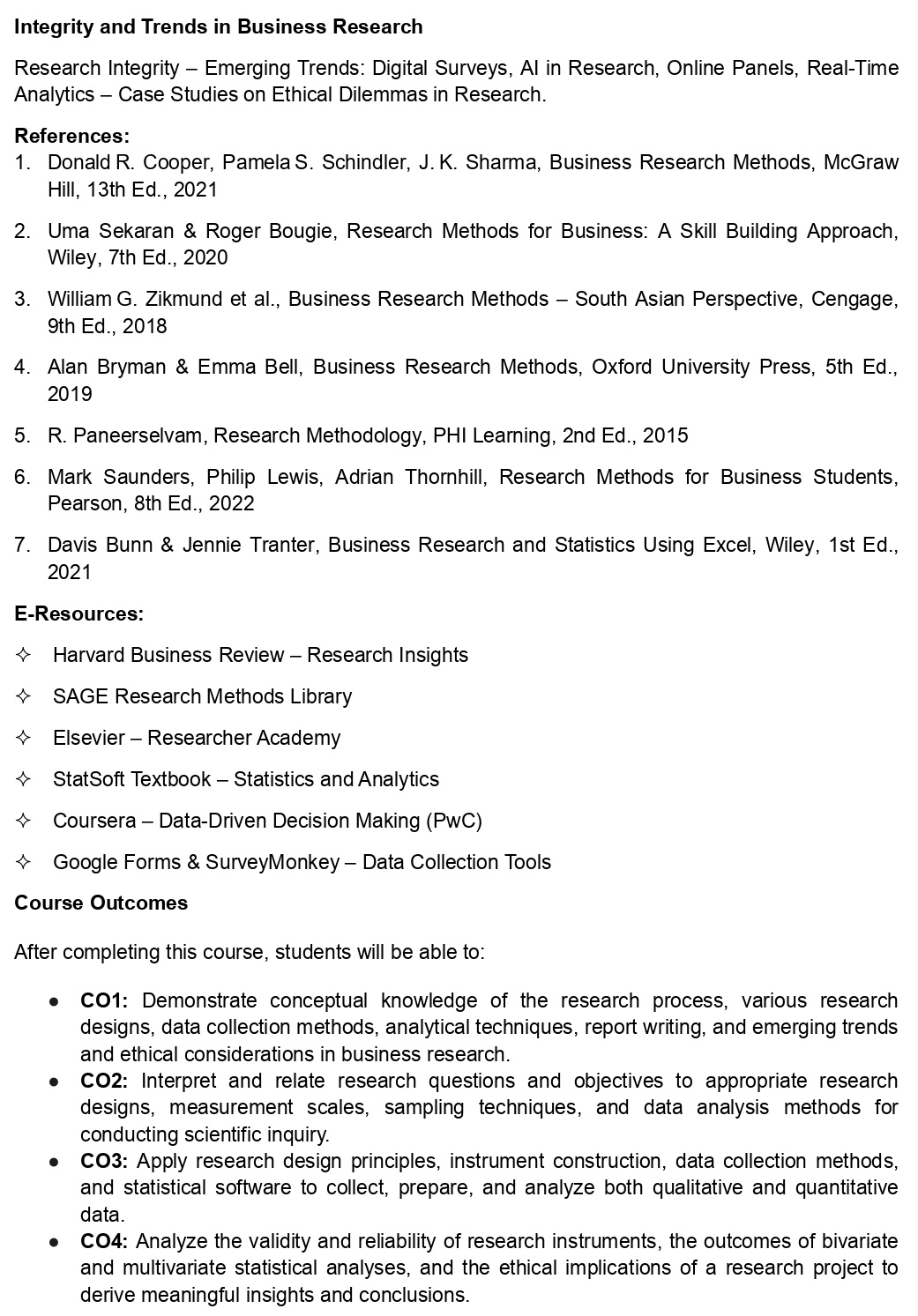
Integrity
and Trends in Business Research
Research
Integrity – Emerging Trends: Digital Surveys, AI in Research, Online Panels,
Real-Time Analytics – Case Studies on Ethical Dilemmas in Research.
References:
1.
Donald R. Cooper, Pamela S. Schindler, J. K. Sharma, Business Research Methods,
McGraw Hill, 13th Ed., 2021
2.
Uma Sekaran & Roger Bougie, Research Methods for Business: A Skill Building
Approach, Wiley, 7th Ed., 2020
3.
William G. Zikmund et al., Business Research Methods – South Asian Perspective,
Cengage, 9th Ed., 2018
4.
Alan Bryman & Emma Bell, Business Research Methods, Oxford University
Press, 5th Ed., 2019
5.
R. Paneerselvam, Research Methodology, PHI Learning, 2nd Ed., 2015
6.
Mark Saunders, Philip Lewis, Adrian Thornhill, Research Methods for Business
Students, Pearson, 8th Ed., 2022
7.
Davis Bunn & Jennie Tranter, Business Research and Statistics Using Excel,
Wiley, 1st Ed., 2021
Course
Outcomes
After completing this course, students will be able to:
● CO1:
Demonstrate conceptual knowledge of the research process, various research
designs, data collection methods, analytical techniques, report writing, and
emerging trends and ethical considerations in business research.
● CO2:
Interpret and relate research questions and objectives to appropriate research
designs, measurement scales, sampling techniques, and data analysis methods for
conducting scientific inquiry.
● CO3:
Apply research design principles, instrument construction, data collection
methods, and statistical software to collect, prepare, and analyze both
qualitative and quantitative data.
● CO4:
Analyze the validity and reliability of research instruments, the outcomes of
bivariate and multivariate statistical analyses, and the ethical implications
of a research project to derive meaningful insights and conclusions.
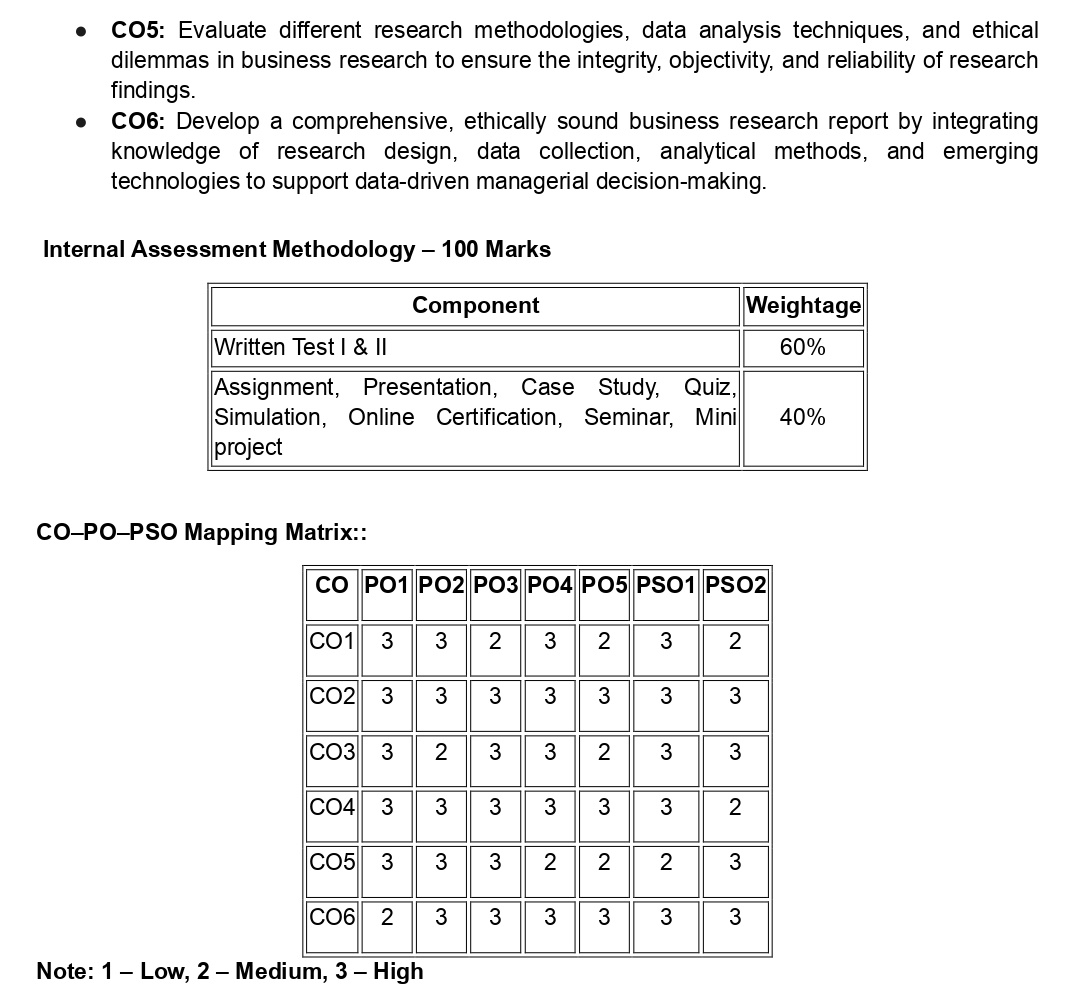
● CO5:
Evaluate different research methodologies, data analysis techniques, and
ethical dilemmas in business research to ensure the integrity, objectivity, and
reliability of research findings.
● CO6:
Develop a comprehensive, ethically sound business research report by
integrating knowledge of research design, data collection, analytical methods,
and emerging technologies to support data-driven managerial decision-making.