Business Analytics - MB25202
[ 2nd Semester - MBA - Master of Business Administration ]
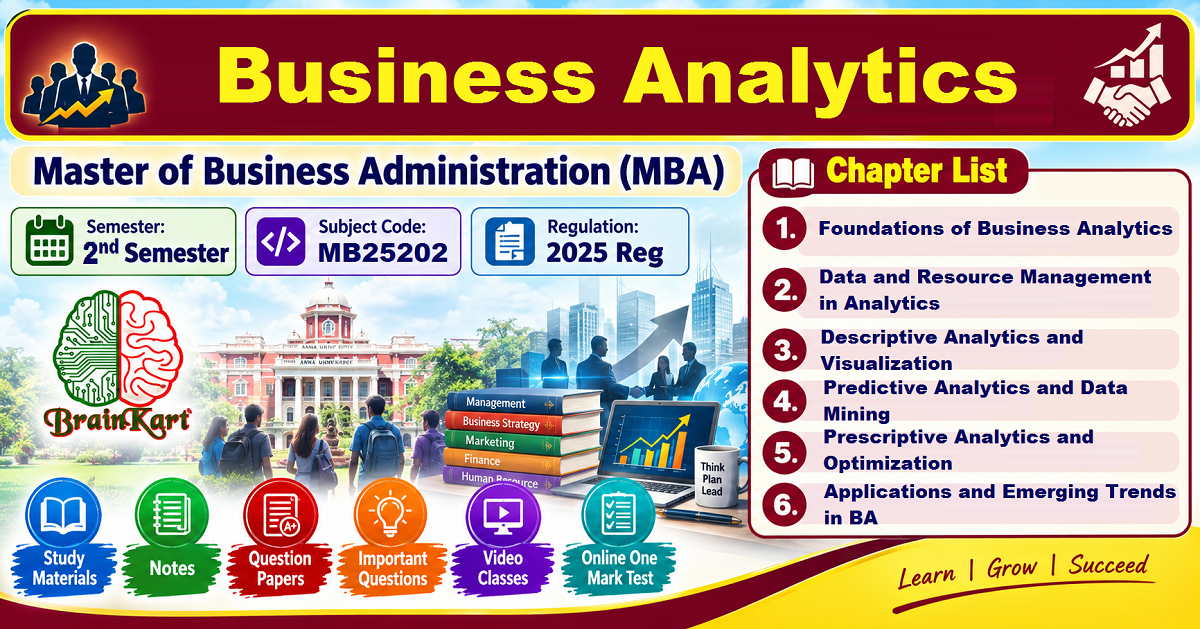
Under Class: | 2nd Semester [MBA Dept Anna University 2025 Regulation] |
Business Analytics - MB25202 - Study Materials, Notes, Important Questions, Anna University Semester Question Paper PDF Download
Mba - Business Analytics - MB25202 Subject (under Anna University 2nd Semester - MBA - Master of Business Administration Regulation 2025) - Study Materials, Written and lecture Notes, Important Questions, Semester Question Paper PDF Download
MB25202:
Business
Analytics
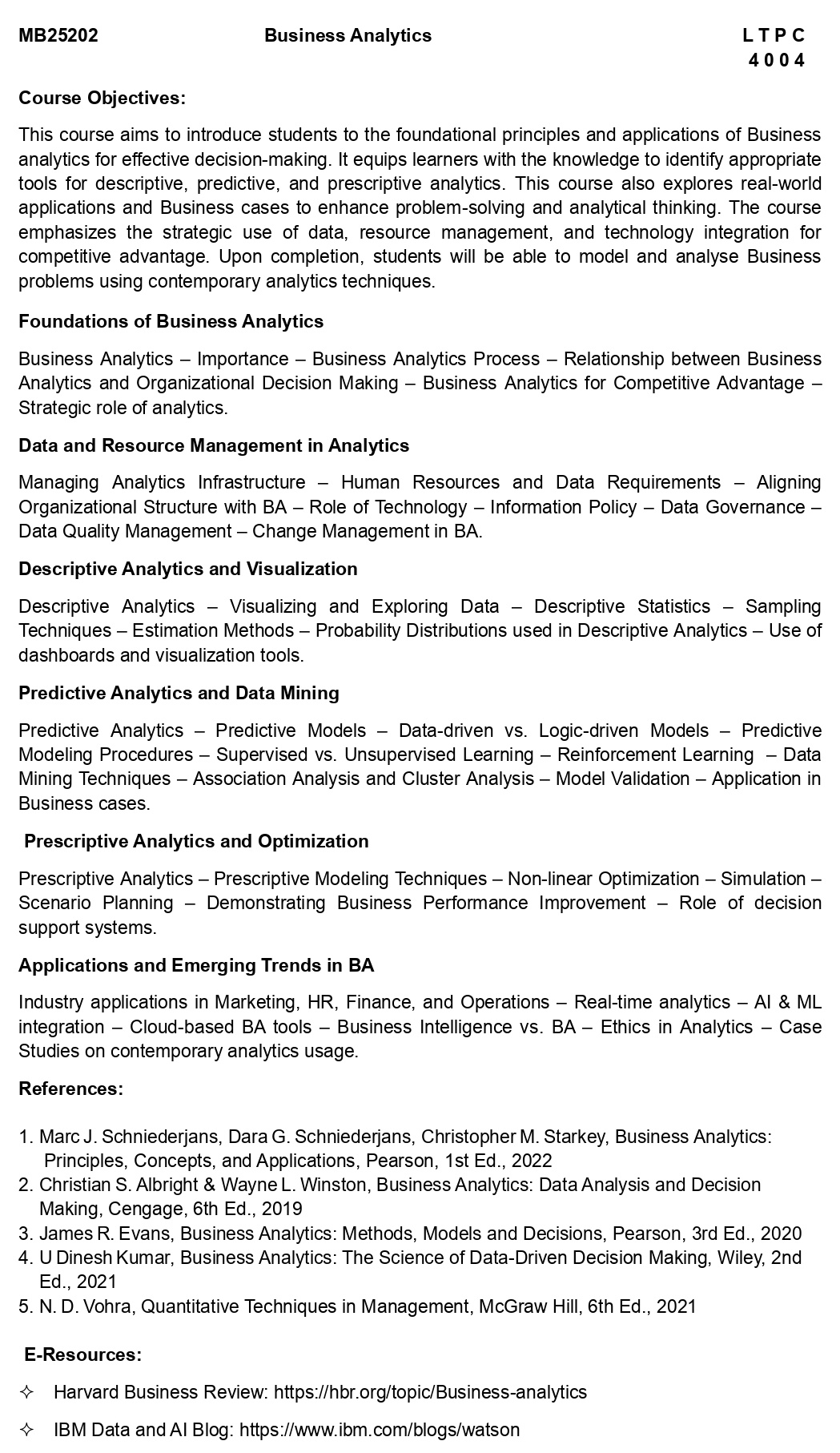
Course Objectives:
This
course aims to introduce students to the foundational principles and
applications of Business analytics for effective decision-making. It equips
learners with the knowledge to identify appropriate tools for descriptive,
predictive, and prescriptive analytics. This course also explores real-world
applications and Business cases to enhance problem-solving and analytical
thinking. The course emphasizes the strategic use of data, resource management,
and technology integration for competitive advantage. Upon completion, students
will be able to model and analyse Business problems using contemporary
analytics techniques.
Foundations
of Business Analytics
Business
Analytics – Importance – Business Analytics Process – Relationship between
Business Analytics and Organizational Decision Making – Business Analytics for
Competitive Advantage – Strategic role of analytics.
Data and
Resource Management in Analytics
Managing
Analytics Infrastructure – Human Resources and Data Requirements – Aligning
Organizational Structure with BA – Role of Technology – Information Policy –
Data Governance – Data Quality Management – Change Management in BA.
Descriptive
Analytics and Visualization
Descriptive
Analytics – Visualizing and Exploring Data – Descriptive Statistics – Sampling
Techniques – Estimation Methods – Probability Distributions used in Descriptive
Analytics – Use of dashboards and visualization tools.
Predictive
Analytics and Data Mining
Predictive
Analytics – Predictive Models – Data-driven vs. Logic-driven Models –
Predictive Modeling Procedures – Supervised vs. Unsupervised Learning –
Reinforcement Learning – Data Mining Techniques – Association Analysis and
Cluster Analysis – Model Validation – Application in Business cases.
Prescriptive
Analytics and Optimization
Prescriptive
Analytics – Prescriptive Modeling Techniques – Non-linear Optimization –
Simulation – Scenario Planning – Demonstrating Business Performance Improvement
– Role of decision support systems.
Applications
and Emerging Trends in BA
Industry
applications in Marketing, HR, Finance, and Operations – Real-time analytics –
AI & ML integration – Cloud-based BA tools – Business Intelligence vs. BA –
Ethics in Analytics – Case Studies on contemporary analytics usage.
References:
1.
Marc J. Schniederjans, Dara G. Schniederjans, Christopher M. Starkey, Business
Analytics: Principles, Concepts, and Applications, Pearson, 1st Ed., 2022
2.
Christian S. Albright & Wayne L. Winston, Business Analytics: Data Analysis
and Decision Making, Cengage, 6th Ed., 2019
3.
James R. Evans, Business Analytics: Methods, Models and Decisions, Pearson, 3rd
Ed., 2020
4.
U Dinesh Kumar, Business Analytics: The Science of Data-Driven Decision Making,
Wiley, 2nd Ed., 2021
5.
N. D. Vohra, Quantitative Techniques in Management, McGraw Hill, 6th Ed., 2021
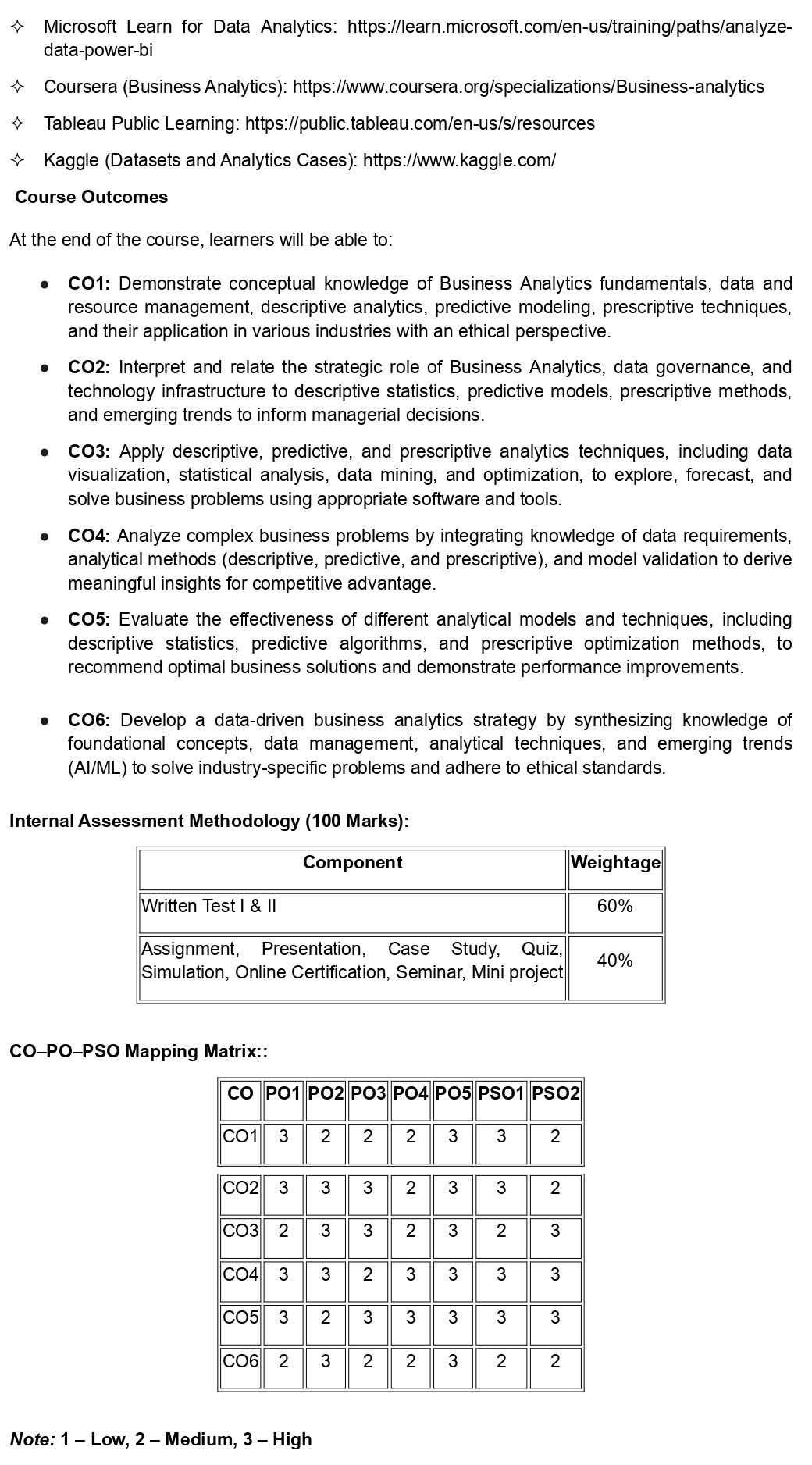
Course
Outcomes
At the end of the course, learners will be able to:
●
CO1: Demonstrate conceptual
knowledge of Business Analytics fundamentals, data and resource management,
descriptive analytics, predictive modeling, prescriptive techniques, and their
application in various industries with an ethical perspective.
●
CO2: Interpret and relate the
strategic role of Business Analytics, data governance, and technology
infrastructure to descriptive statistics, predictive models, prescriptive
methods, and emerging trends to inform managerial decisions.
●
CO3: Apply descriptive, predictive,
and prescriptive analytics techniques, including data visualization,
statistical analysis, data mining, and optimization, to explore, forecast, and
solve business problems using appropriate software and tools.
●
CO4: Analyze complex business
problems by integrating knowledge of data requirements, analytical methods
(descriptive, predictive, and prescriptive), and model validation to derive
meaningful insights for competitive advantage.
●
CO5: Evaluate the effectiveness of
different analytical models and techniques, including descriptive statistics,
predictive algorithms, and prescriptive optimization methods, to recommend
optimal business solutions and demonstrate performance improvements.
●
CO6: Develop a data-driven business
analytics strategy by synthesizing knowledge of foundational concepts, data
management, analytical techniques, and emerging trends (AI/ML) to solve
industry-specific problems and adhere to ethical standards.