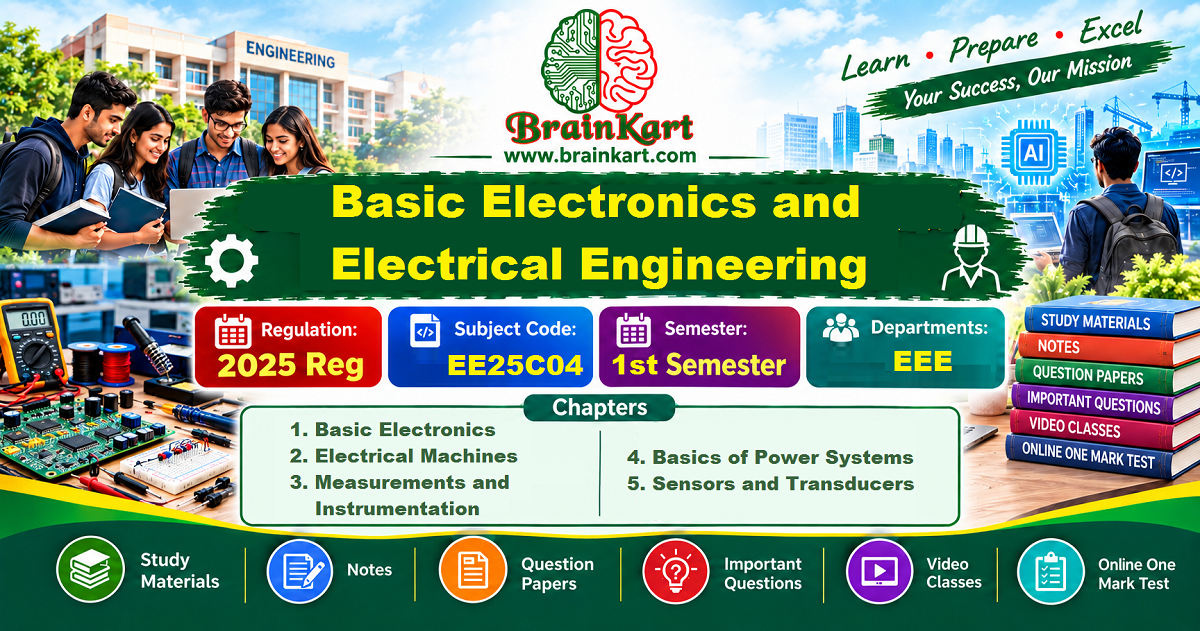
Basic Electronics and Electrical Engineering - EE25C04
[ 1st Semester - ECE - Electronics and Communication Engineering Department ]
Under Class: | 1st Semester [ECE Dept Anna University 2025 Regulation] |
Basic Electronics and Electrical Engineering - EE25C04 - Study Materials, Notes, Important Questions, Anna University Semester Question Paper PDF Download
Engineering - Basic Electronics and Electrical Engineering - EE25C04 Subject (under Anna University 1st Semester - Engineering Regulation 2025) - Study Materials, Written and lecture Notes, Important Questions, Semester Question Paper PDF Download
EE25C04:
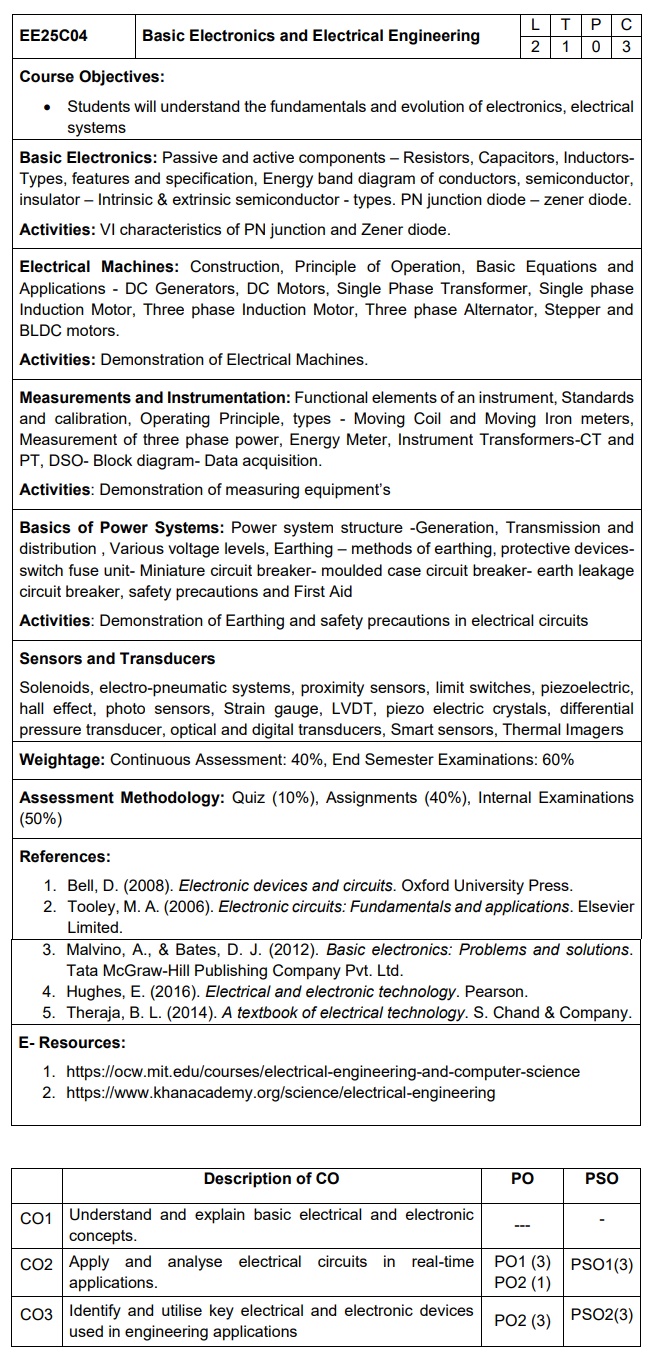
Basic Electronics and Electrical Engineering
Course
Objectives:
•
Students will understand the fundamentals and evolution of electronics,
electrical systems
Basic
Electronics: Passive and active components –
Resistors, Capacitors, Inductors-Types, features and specification, Energy band
diagram of conductors, semiconductor, insulator – Intrinsic & extrinsic
semiconductor - types. PN junction diode – zener diode.
Activities:
VI characteristics of PN junction and Zener diode.
Electrical
Machines: Construction, Principle of Operation,
Basic Equations and Applications - DC Generators, DC Motors, Single Phase
Transformer, Single phase Induction Motor, Three phase Induction Motor, Three
phase Alternator, Stepper and BLDC motors.
Activities:
Demonstration of Electrical Machines.
Measurements
and Instrumentation: Functional elements of an
instrument, Standards and calibration, Operating Principle, types - Moving Coil
and Moving Iron meters, Measurement of three phase power, Energy Meter,
Instrument Transformers-CT and PT, DSO- Block diagram- Data acquisition.
Activities:
Demonstration of measuring equipment’s
Basics of
Power Systems: Power system structure -Generation,
Transmission and distribution , Various voltage levels, Earthing – methods of
earthing, protective devices-switch fuse unit- Miniature circuit breaker-
moulded case circuit breaker- earth leakage circuit breaker, safety precautions
and First Aid
Activities:
Demonstration of Earthing and safety precautions in electrical circuits
Sensors
and Transducers
Solenoids,
electro-pneumatic systems, proximity sensors, limit switches, piezoelectric,
hall effect, photo sensors, Strain gauge, LVDT, piezo electric crystals,
differential
pressure
transducer, optical and digital transducers, Smart sensors, Thermal Imagers
Weightage:
Continuous Assessment: 40%, End Semester Examinations: 60%
Assessment Methodology:
Quiz (10%), Assignments (40%), Internal Examinations (50%)
References:
1.
Bell, D. (2008). Electronic devices and circuits. Oxford University Press.
2.
Tooley, M. A. (2006). Electronic circuits: Fundamentals and applications.
Elsevier Limited.
3.
Malvino, A., & Bates, D. J. (2012). Basic electronics: Problems and
solutions. Tata McGraw-Hill Publishing Company Pvt. Ltd.
4.
Hughes, E. (2016). Electrical and electronic technology. Pearson.
5.
Theraja, B. L. (2014). A textbook of electrical technology. S. Chand &
Company.
E- Resources:
1.
https://ocw.mit.edu/courses/electrical-engineering-and-computer-science
2.
https://www.khanacademy.org/science/electrical-engineering