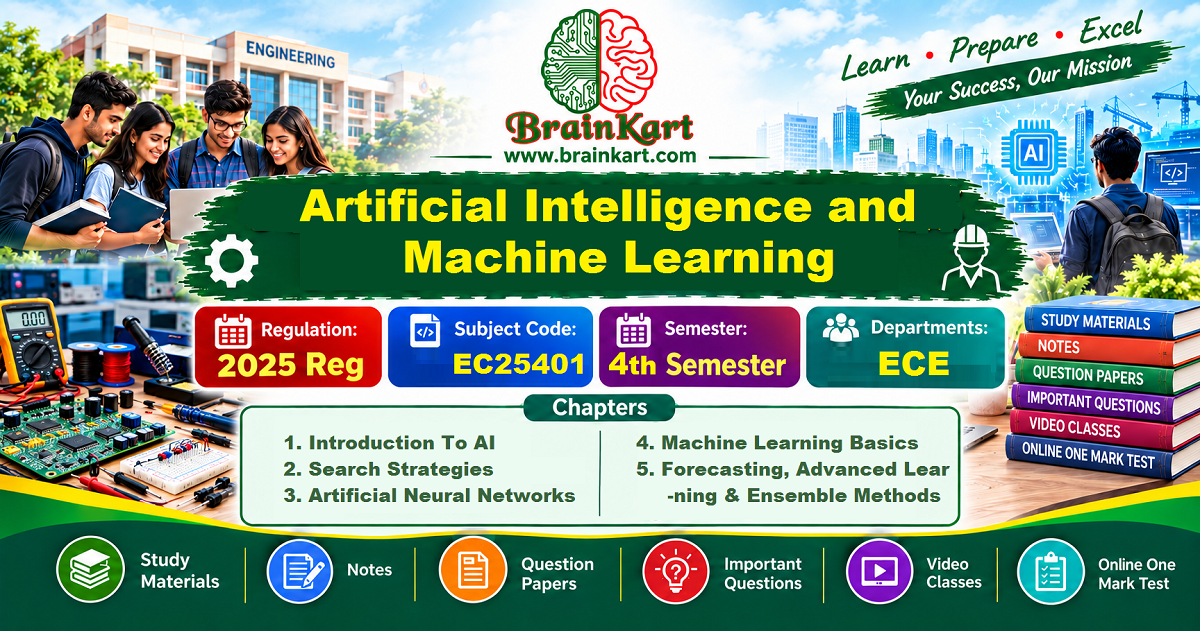
Artificial Intelligence and Machine Learning - EC25401
[ 4th Semester - ECE - Electronics and Communication Engineering Department ]
Under Class: | 4th Semester [ECE Dept Anna University 2025 Regulation] |
Artificial Intelligence and Machine Learning - EC25401 - Study Materials, Notes, Important Questions, Anna University Semester Question Paper PDF Download
Engineering - Artificial Intelligence and Machine Learning - EC25401 Subject (under Anna University 4th Semester - ECE - Electronics and Communication Engineering Department Regulation 2025) - Study Materials, Written and lecture Notes, Important Questions, Semester Question Paper PDF Download
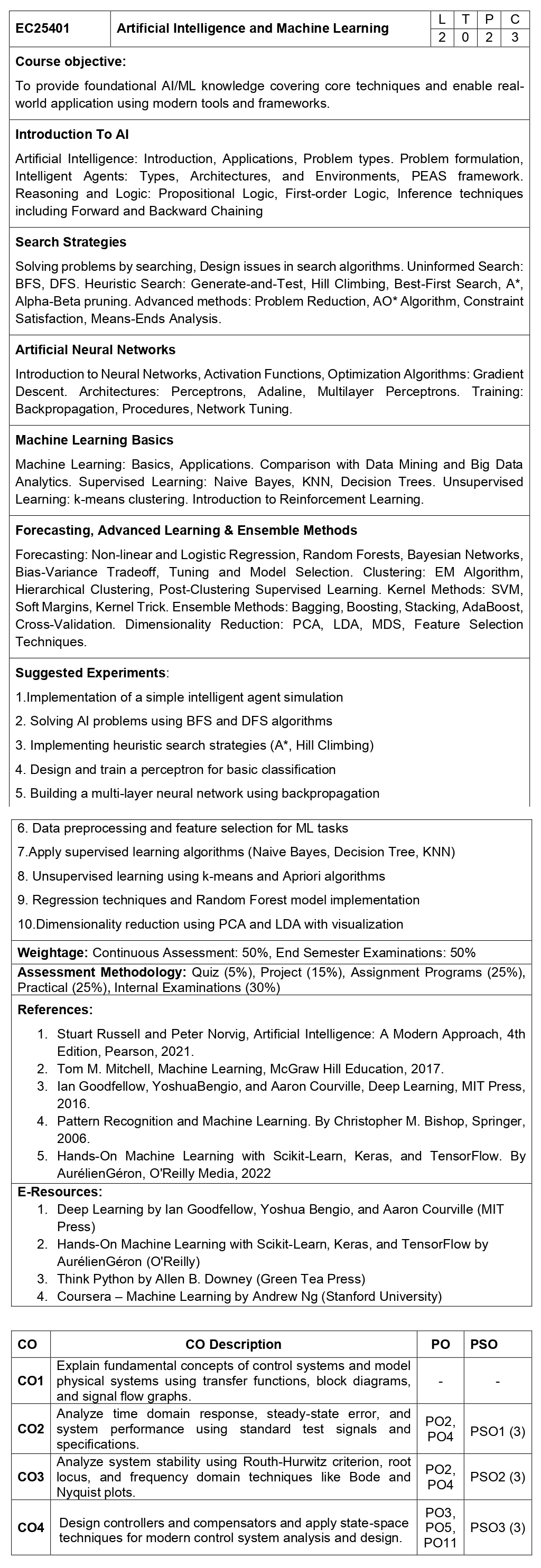
EC25401:
Artificial
Intelligence and Machine Learning
Course
objective:
To
provide foundational AI/ML knowledge covering core techniques and enable
real-world application using modern tools and frameworks.
Introduction
To AI
Artificial
Intelligence: Introduction, Applications, Problem types. Problem formulation,
Intelligent Agents: Types, Architectures, and Environments, PEAS framework.
Reasoning and Logic: Propositional Logic, First-order Logic, Inference
techniques including Forward and Backward Chaining
Search
Strategies
Solving
problems by searching, Design issues in search algorithms. Uninformed Search:
BFS, DFS. Heuristic Search: Generate-and-Test, Hill Climbing, Best-First
Search, A*, Alpha-Beta pruning. Advanced methods: Problem Reduction, AO* Algorithm,
Constraint Satisfaction, Means-Ends Analysis.
Artificial
Neural Networks
Introduction
to Neural Networks, Activation Functions, Optimization Algorithms: Gradient
Descent. Architectures: Perceptrons, Adaline, Multilayer Perceptrons. Training:
Backpropagation, Procedures, Network Tuning.
Machine
Learning Basics
Machine
Learning: Basics, Applications. Comparison with Data Mining and Big Data
Analytics. Supervised Learning: Naive Bayes, KNN, Decision Trees. Unsupervised
Learning: k-means clustering. Introduction to Reinforcement Learning.
Forecasting,
Advanced Learning & Ensemble Methods
Forecasting:
Non-linear and Logistic Regression, Random Forests, Bayesian Networks,
Bias-Variance Tradeoff, Tuning and Model Selection. Clustering: EM Algorithm, Hierarchical
Clustering, Post-Clustering Supervised Learning. Kernel Methods: SVM, Soft
Margins, Kernel Trick. Ensemble Methods: Bagging, Boosting, Stacking, AdaBoost,
Cross-Validation. Dimensionality Reduction: PCA, LDA, MDS, Feature Selection
Techniques.
Suggested
Experiments:
1.
Implementation of a simple intelligent agent simulation
2.
Solving AI problems using BFS and DFS algorithms
3.
Implementing heuristic search strategies (A*, Hill Climbing)
4.
Design and train a perceptron for basic classification
5.
Building a multi-layer neural network using backpropagation
6.
Data preprocessing and feature selection for ML tasks
7.
Apply supervised learning algorithms (Naive Bayes, Decision Tree, KNN)
8.
Unsupervised learning using k-means and Apriori algorithms
9.
Regression techniques and Random Forest model implementation
10.
Dimensionality reduction using PCA and LDA with visualization
Weightage:
Continuous Assessment: 50%, End Semester Examinations: 50%
Assessment Methodology:
Quiz (5%), Project (15%), Assignment Programs (25%),
Practical
(25%), Internal Examinations (30%)
References:
1.
Stuart Russell and Peter Norvig, Artificial Intelligence: A Modern Approach,
4th Edition, Pearson, 2021.
2.
Tom M. Mitchell, Machine Learning, McGraw Hill Education, 2017.
3.
Ian Goodfellow, YoshuaBengio, and Aaron Courville, Deep Learning, MIT Press, 2016.
4.
Pattern Recognition and Machine Learning. By Christopher M. Bishop, Springer,
2006.
5.
Hands-On Machine Learning with Scikit-Learn, Keras, and TensorFlow. By
AurélienGéron,
O'Reilly Media, 2022