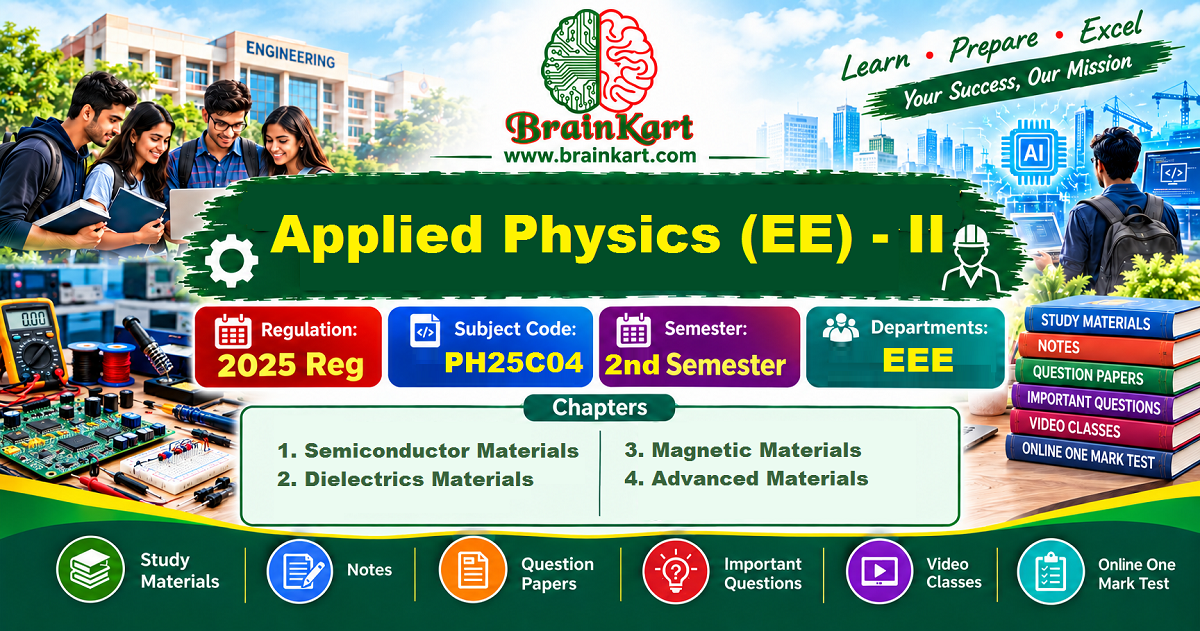
Applied Physics (EE) II - PH25C04
[ 2nd Semester - EEE - Electrical and Electronics Engineering Department ]
Under Class: | 2nd Semester [EEE Dept Anna University 2025 Regulation] |
Applied Physics (EE) II - PH25C04 - Study Materials, Notes, Important Questions, Anna University Semester Question Paper PDF Download
Engineering - Applied Physics (EE) II - PH25C04 Subject (under Anna University 2nd Semester - EEE - Electrical and Electronics Engineering Department Regulation 2025) - Study Materials, Written and lecture Notes, Important Questions, Semester Question Paper PDF Download
PH25C04:
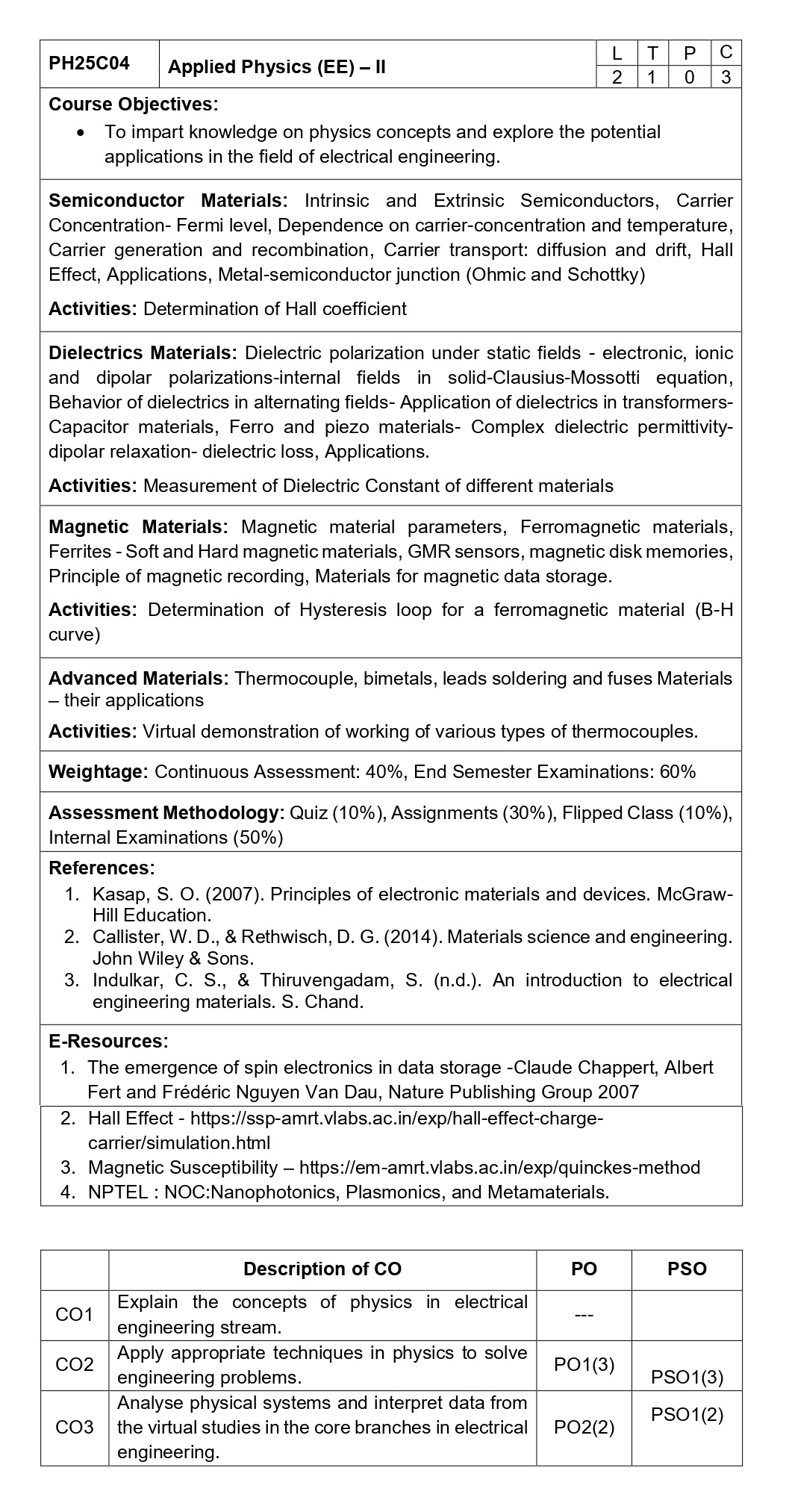
Applied Physics (EE) – II
Course
Objectives:
•
To impart knowledge on physics concepts and explore the potential applications
in the field of electrical engineering.
Semiconductor
Materials: Intrinsic and Extrinsic Semiconductors
- Carrier Concentration- Fermi level -Dependence on carrier-concentration and
temperature-Carrier generation and recombination-Carrier transport: diffusion
and drift- Hall Effect – Applications- Metal-semiconductor junction (Ohmic and
Schottky)
Activities:
Determination of Hall coefficient
Dielectrics
Materials: Dielectric polarization under static
fields - electronic, ionic and dipolar polarizations-internal fields in
solid-Clausius-Mossotti equation - Behavior of dielectrics in alternating
fields- Application of dielectrics in transformers-Capacitor materials – Ferro
and piezo materials- Complex dielectric permittivity-dipolar relaxation-
dielectric loss- Applications.
Activities:
Measurement of Dielectric Constant of different materials
Magnetic
Materials: Magnetic material parameters
–Ferromagnetic materials – Ferrites - Soft and Hard magnetic materials – GMR
sensors - magnetic disk memories – Principle of magnetic recording – Materials
for magnetic data storage.
Activities:
Determination of Hysteresis loop for a ferromagnetic material (B-H curve)
Advanced
Materials: Thermocouple, bimetals, leads soldering
and fuses Materials – their applications
Activities:
Virtual demonstration of working of various types of thermocouples.
Weightage:
Continuous Assessment: 40%, End Semester Examinations: 60%
Assessment Methodology:
Quiz (10%), Assignments (30%), Flipped Class (10%),
Internal
Examinations (50%)
References:
1.
Kasap, S. O. (2007). Principles of electronic materials and devices. McGraw-
Hill Education.
2.
Callister, W. D., & Rethwisch, D. G. (2014). Materials science and
engineering. John Wiley & Sons.
3.
Indulkar, C. S., & Thiruvengadam, S. (n.d.). An introduction to electrical
engineering materials. S. Chand.
E-Resources:
1.
The emergence of spin electronics in data storage -Claude Chappert, Albert Fert
and Frédéric Nguyen Van Dau, Nature Publishing Group 2007
2.
Hall Effect - https://ssp-amrt.vlabs.ac.in/exp/hall-effect-charge-
carrier/simulation.html
3.
Magnetic Susceptibility – https://em-amrt.vlabs.ac.in/exp/quinckes-method
4.
NPTEL : NOC:Nanophotonics, Plasmonics, and Metamaterials.