Applied Physics (CE) II - PH25C02
[ 2nd Semester - Civil, Agriculture Engineering Departments ]
Under Class: | 2nd Semester [Civil Dept Anna University 2025 Regulation] | | 2nd Semester [Agricultural Dept Anna University 2025 Regulation] |
Applied Physics (CE) II - PH25C02 - Study Materials, Notes, Important Questions, Anna University Semester Question Paper PDF Download
Engineering - Applied Physics (CE) II - PH25C02 Subject (under Anna University 2nd Semester - Civil, Agriculture Engineering Departments Regulation 2025) - Study Materials, Written and lecture Notes, Important Questions, Semester Question Paper PDF Download
PH25C02:
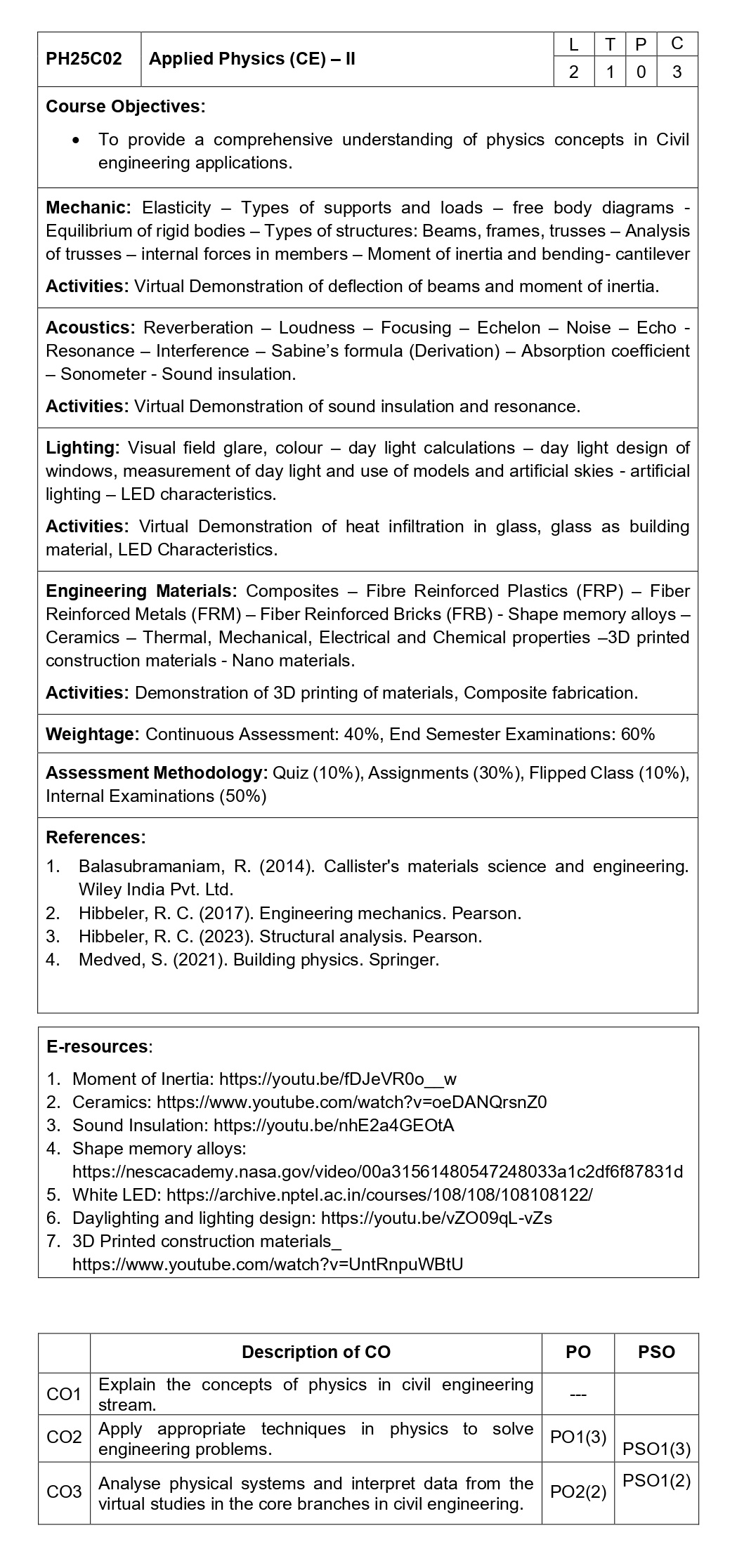
Applied Physics (CE) – II
Course
Objectives:
•
To provide a comprehensive understanding of physics concepts in Civil
engineering applications.
Mechanic:
Elasticity – Types of supports and loads – free body diagrams - Equilibrium of
rigid bodies – Types of structures: Beams, frames, trusses – Analysis of
trusses – internal forces in members – Moment of inertia and bending-
cantilever
Activities:
Virtual Demonstration of deflection of beams and moment of inertia.
Acoustics:
Reverberation – Loudness – Focusing – Echelon – Noise – Echo - Resonance –
Interference – Sabine’s formula (Derivation) – Absorption coefficient –
Sonometer - Sound insulation.
Activities:
Virtual Demonstration of sound insulation and resonance.
Lighting:
Visual field glare, colour – day light calculations – day light design of
windows, measurement of day light and use of models and artificial skies -
artificial lighting – LED characteristics.
Activities: Virtual
Demonstration of heat infiltration in glass, glass as building material, LED
Characteristics.
Engineering
Materials: Composites – Fibre Reinforced Plastics
(FRP) – Fiber Reinforced Metals (FRM) – Fiber Reinforced Bricks (FRB) - Shape
memory alloys – Ceramics – Thermal, Mechanical, Electrical and Chemical
properties –3D printed construction materials
-
Nano materials.
Activities:
Demonstration of 3D printing of materials, Composite fabrication.
Weightage:
Continuous Assessment: 40%, End Semester Examinations: 60%
Methodology for
Continuous Assessment: Quiz (10%), Assignments (30%),
Flipped Class (10%), Internal Examinations (50%)
References:
1.
Balasubramaniam, R. (2014). Callister's materials science and engineering.
Wiley India Pvt. Ltd.
2.
Hibbeler, R. C. (2017). Engineering mechanics. Pearson.
3.
Hibbeler, R. C. (2023). Structural analysis. Pearson.
4.
Medved, S. (2021). Building physics. Springer.
E-resources:
1.
Moment of Inertia: https://youtu.be/fDJeVR0o w
2.
Ceramics: https://www.youtube.com/watch?v=oeDANQrsnZ0
3.
Sound Insulation: https://youtu.be/nhE2a4GEOtA
4.
Shape memory alloys:
https://nescacademy.nasa.gov/video/00a31561480547248033a1c2df6f87831d
5.
White LED: https://archive.nptel.ac.in/courses/108/108/108108122/
6.
Daylighting and lighting design: https://youtu.be/vZO09qL-vZs
7.
3D Printed construction materials_ https://www.youtube.com/watch?v=UntRnpuWBtU