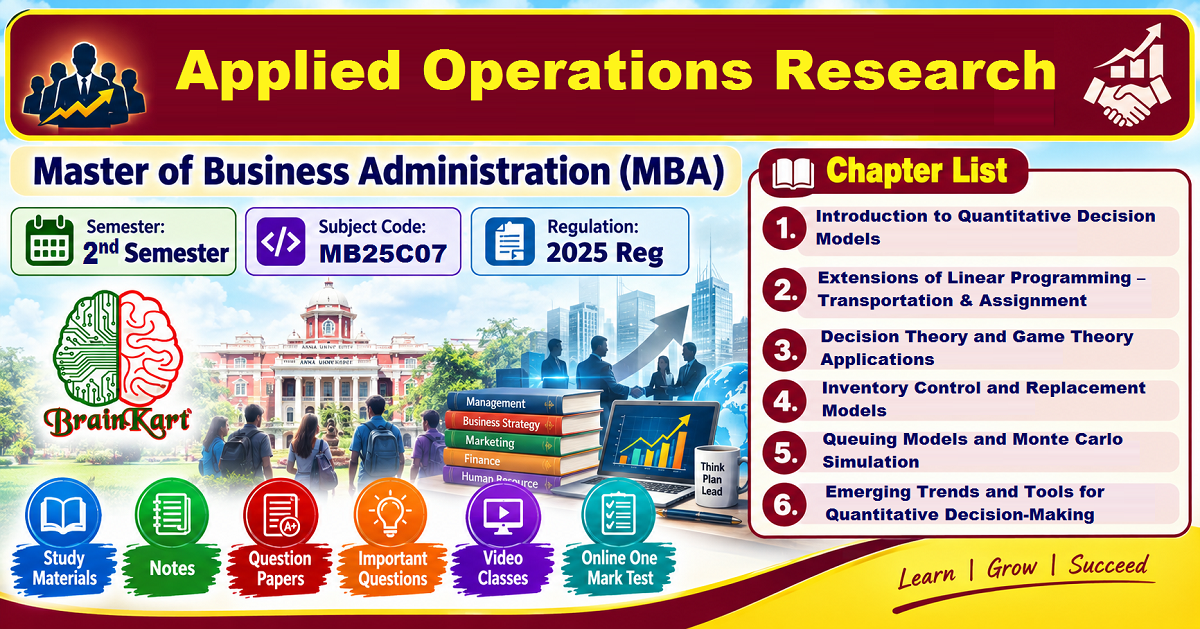
Applied Operations Research - MB25C07
[ 2nd Semester - MBA - Master of Business Administration ]
Under Class: | 2nd Semester [MBA Dept Anna University 2025 Regulation] |
Applied Operations Research - MB25C07 - Study Materials, Notes, Important Questions, Anna University Semester Question Paper PDF Download
Mba - Applied Operations Research - MB25C07 Subject (under Anna University 2nd Semester - MBA - Master of Business Administration Regulation 2025) - Study Materials, Written and lecture Notes, Important Questions, Semester Question Paper PDF Download
MB25C07:
Applied
Operations Research
Course Objectives:
This
course equips students with analytical and quantitative tools essential for
modeling and solving complex Business problems. It emphasizes linear
programming, decision theory, inventory models, queuing systems, and simulation
techniques, enabling data-driven decision-making in logistics, finance,
operations, and project management. Learners will gain proficiency in applying
optimization and statistical modeling techniques using spreadsheet-based tools
and modern software applications. The course prepares students to assess
real-time scenarios with practical, strategic, and computational approaches to
decision-making.
Introduction
to Quantitative Decision Models
Relevance
of quantitative techniques in management decision making. Linear Programming
formulation, solution by graphical and simplex methods (Primal - Penalty, Two
Phase), Special cases. Sensitivity Analysis. (Theory and Problem)
Extensions
of Linear Programming – Transportation & Assignment (Problems)
Transportation
Models (Minimising and Maximising Problems) – Balanced and unbalanced Problems
– Initial Basic feasible solution by N-W Corner Rule, Least cost and Vogel’s
approximation methods. Check for optimality. Solution by MODI / Stepping Stone
method. Case of Degeneracy. Transhipment Models. Assignment Models (Minimising
and Maximising Problems) – Balanced and Unbalanced Problems. Solution by
Hungarian and Branch and Bound Algorithms. Travelling Salesman problem. Crew
Assignment Models.
Decision
Theory and Game Theory Applications (Theory and Problem)
Decision
making under risk – Decision trees – Decision making under uncertainty. Game
Theory-Two-person Zero sum games-Saddle point, Dominance Rule, Convex Linear
Combination (Averages), methods of matrices, graphical and LP solutions.
Inventory
Control and Replacement Models (Theory and Problem)
Inventory
Models – EOQ and EBQ Models (With and without shortages), Quantity Discount
Models. Replacement Models-Individual replacement Models (With and without time
value of money) – Group Replacement Models.
Queuing
Models and Monte Carlo Simulation (Problem)
Queuing
Theory - single and multi-channel models – infinite number of customers and
infinite calling source. Monte Carlo simulation – use of random numbers,
application of simulation techniques
Emerging
Trends and Tools for Quantitative Decision-Making (Theory and Problem)
Integration
of quantitative techniques in Business analytics – Use of Excel Solver, R, and
Python in operations research – Introduction to prescriptive analytics.
References:
1.
Hamdy A. Taha, Operations Research: An Introduction, 11th Ed., Pearson
Education, 2022
2.
G. Srinivasan, Operations Research: Principles and Applications, PHI Learning,
2nd Ed., 2011
3.
N. D. Vohra, Quantitative Techniques in Management, Tata McGraw Hill,2010
4.
R. Paneerselvam, Operations Research, PHI Learning, 4th Ed., 2018
5.
Frederick Hillier & Mark Hillier, Introduction to Management Science,
McGraw Hill India, 6th Ed., 2023
6.
Bernard W. Taylor III, Introduction to Management Science, Pearson, 9th Ed.,
2020
7.
S. Kalavathy, Operations Research, Vikas Publishing House, 4th Ed., 2022
8.
Nagraj B., Barry R. & Ralph M. S. Jr., Managerial Decision Modelling with
Spreadsheets, Pearson Education, 2nd Ed., 2007
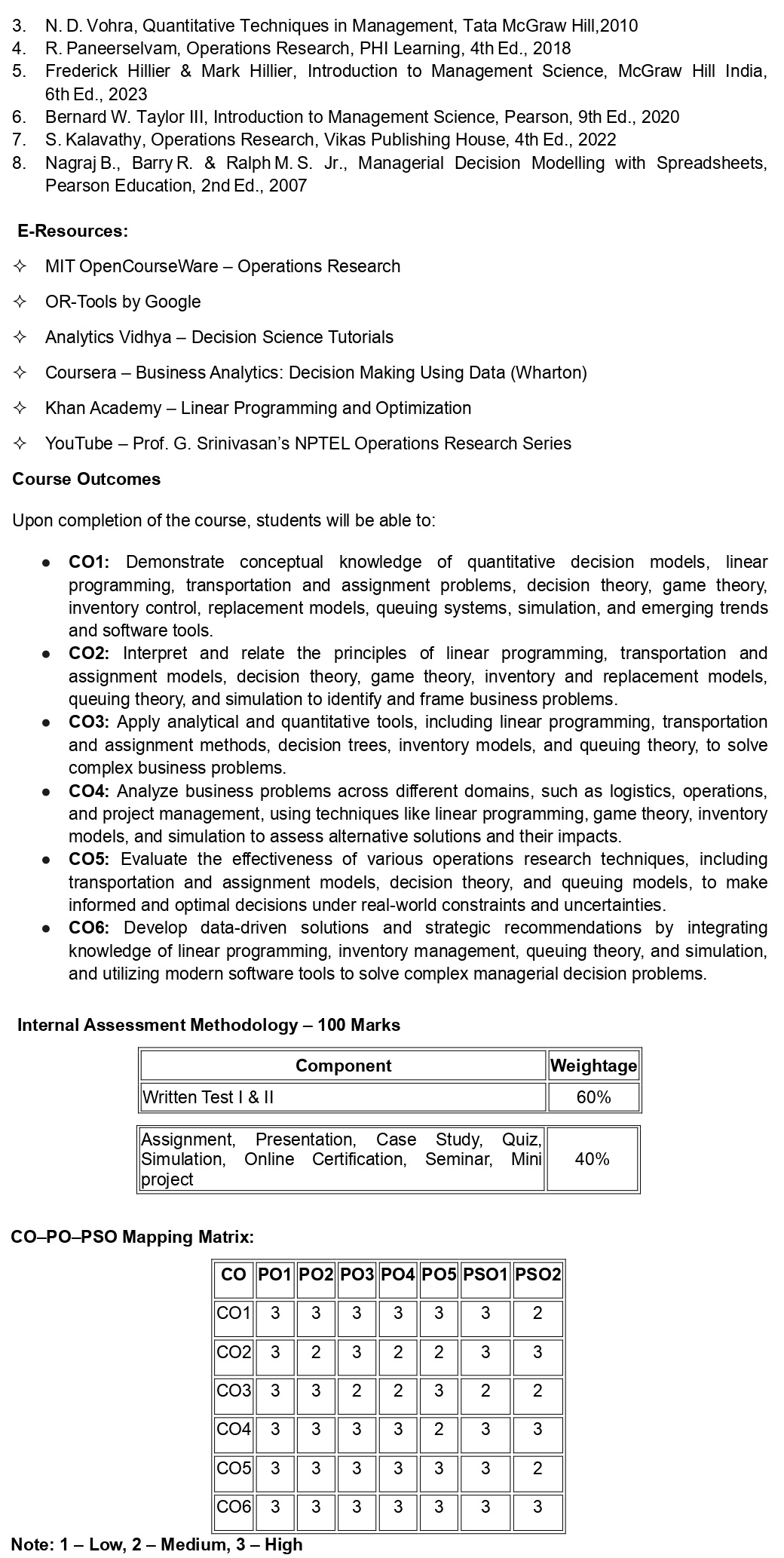
Course
Outcomes
Upon
completion of the course, students will be able to:
●
CO1: Demonstrate conceptual
knowledge of quantitative decision models, linear programming, transportation
and assignment problems, decision theory, game theory, inventory control,
replacement models, queuing systems, simulation, and emerging trends and
software tools.
●
CO2: Interpret and relate the
principles of linear programming, transportation and assignment models,
decision theory, game theory, inventory and replacement models, queuing theory,
and simulation to identify and frame business problems.
●
CO3: Apply analytical and
quantitative tools, including linear programming, transportation and assignment
methods, decision trees, inventory models, and queuing theory, to solve complex
business problems.
●
CO4: Analyze business problems
across different domains, such as logistics, operations, and project
management, using techniques like linear programming, game theory, inventory
models, and simulation to assess alternative solutions and their impacts.
●
CO5: Evaluate the effectiveness of
various operations research techniques, including transportation and assignment
models, decision theory, and queuing models, to make informed and optimal
decisions under real-world constraints and uncertainties.
●
CO6: Develop data-driven solutions
and strategic recommendations by integrating knowledge of linear programming,
inventory management, queuing theory, and simulation, and utilizing modern
software tools to solve complex managerial decision problems.