Applied Engineering Mechanics - ME25C07
[ 3rd Semester - Mechanical Engineering Department ]
Under Class: | 3rd Semester [Mechanical Dept Anna University 2025 Regulation] |
Applied Engineering Mechanics - ME25C07 - Study Materials, Notes, Important Questions, Anna University Semester Question Paper PDF Download
Engineering - Applied Engineering Mechanics - ME25C07 Subject (under Anna University 3rd Semester - Mechanical Engineering Department Regulation 2025) - Study Materials, Written and lecture Notes, Important Questions, Semester Question Paper PDF Download
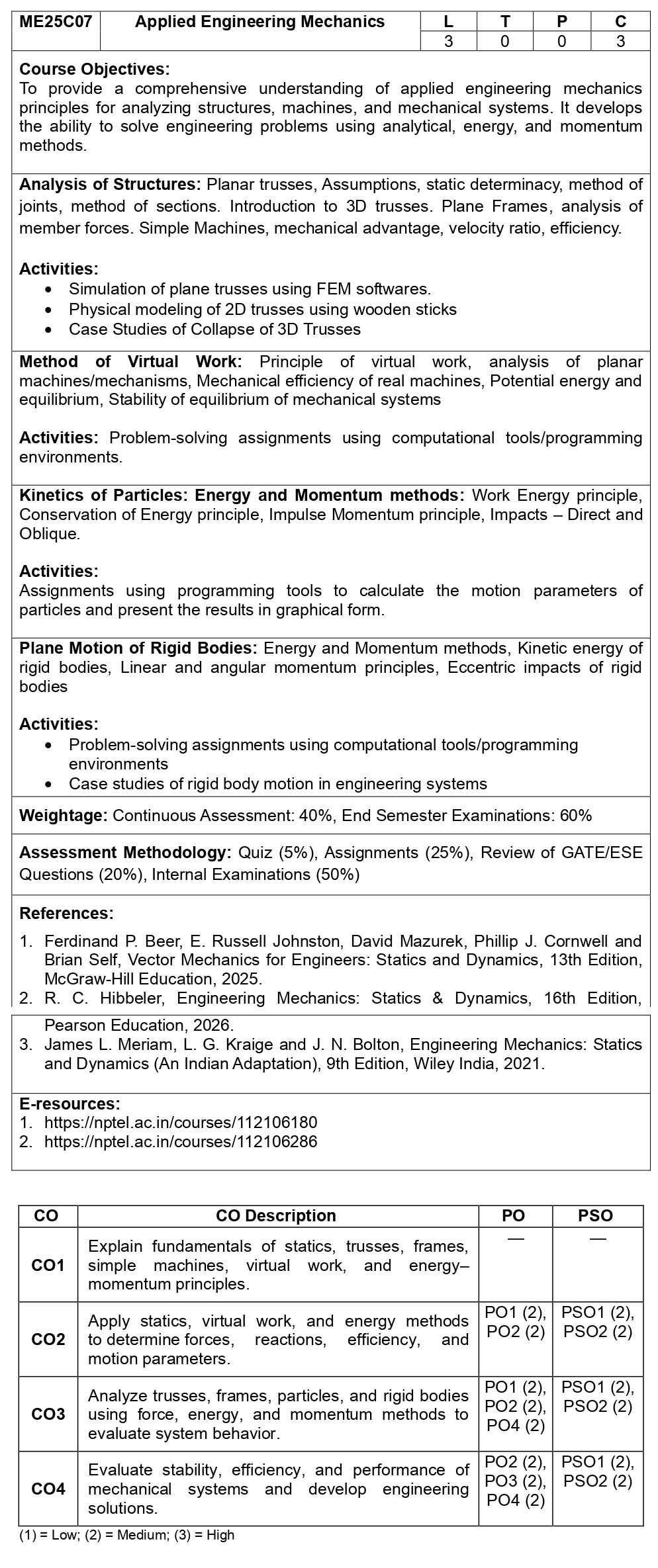
ME25C07
Applied
Engineering Mechanics
Course
Objectives:
To
provide a comprehensive understanding of applied engineering mechanics
principles for analyzing structures, machines, and mechanical systems. It
develops the ability to solve engineering problems using analytical, energy,
and momentum methods.
Analysis
of Structures: Planar trusses, Assumptions, static
determinacy, method of joints, method of sections. Introduction to 3D trusses.
Plane Frames, analysis of member forces. Simple Machines, mechanical advantage,
velocity ratio, efficiency.
•
Simulation of plane trusses using FEM softwares.
•
Physical modeling of 2D trusses using wooden sticks
•
Case Studies of Collapse of 3D Trusses
Method of
Virtual Work: Principle of virtual work, analysis of
planar machines/mechanisms, Mechanical efficiency of real machines, Potential
energy and equilibrium, Stability of equilibrium of mechanical systems
Activities:
Problem-solving assignments using computational tools/programming environments.
Kinetics
of Particles: Energy and Momentum methods: Work
Energy principle, Conservation of Energy principle, Impulse Momentum principle,
Impacts – Direct and Oblique.
Activities:
Assignments
using programming tools to calculate the motion parameters of particles and
present the results in graphical form.
Plane
Motion of Rigid Bodies: Energy and Momentum methods,
Kinetic energy of rigid bodies, Linear and angular momentum principles,
Eccentric impacts of rigid bodies
Activities:
•
Problem-solving assignments using computational tools/programming environments
•
Case studies of rigid body motion in engineering systems
Weightage:
Continuous Assessment: 40%, End Semester Examinations: 60%
Assessment Methodology:
Quiz (5%), Assignments (25%), Review of GATE/ESE Questions (20%), Internal
Examinations (50%)
References:
1.
Ferdinand P. Beer, E. Russell Johnston, David Mazurek, Phillip J. Cornwell and
Brian Self, Vector Mechanics for Engineers: Statics and Dynamics, 13th Edition,
McGraw-Hill Education, 2025.
2.
R. C. Hibbeler, Engineering Mechanics: Statics & Dynamics, 16th Edition, Pearson
Education, 2026.
3.
James L. Meriam, L. G. Kraige and J. N. Bolton, Engineering Mechanics: Statics
and Dynamics (An Indian Adaptation), 9th Edition, Wiley India, 2021.