Applied Calculus - MA25C01
[ 1st Semester - Engineering ]
Under Class: | 1st Semester [EEE Dept Anna University 2025 Regulation] | | 1st Semester [ECE Dept Anna University 2025 Regulation] | | 1st Semester [Mechanical Dept Anna University 2025 Regulation] | | 1st Semester [Civil Dept Anna University 2025 Regulation] | | 1st Semester [Agricultural Dept Anna University 2025 Regulation] | | 1st Semester [CSE Dept Anna University 2025 Regulation] | | 1st Semester [CSE(CY) Dept Anna University 2025 Regulation] | | 1st Semester [AIDS Dept Anna University 2025 Regulation] | | 1st Semester [IT Dept Anna University 2025 Regulation] |
Applied Calculus - MA25C01 - Study Materials, Notes, Important Questions, Anna University Semester Question Paper PDF Download
Engineering - Applied Calculus - MA25C01 Subject (under Anna University 1st Semester - Engineering Regulation 2025) - Study Materials, Written and lecture Notes, Important Questions, Semester Question Paper PDF Download
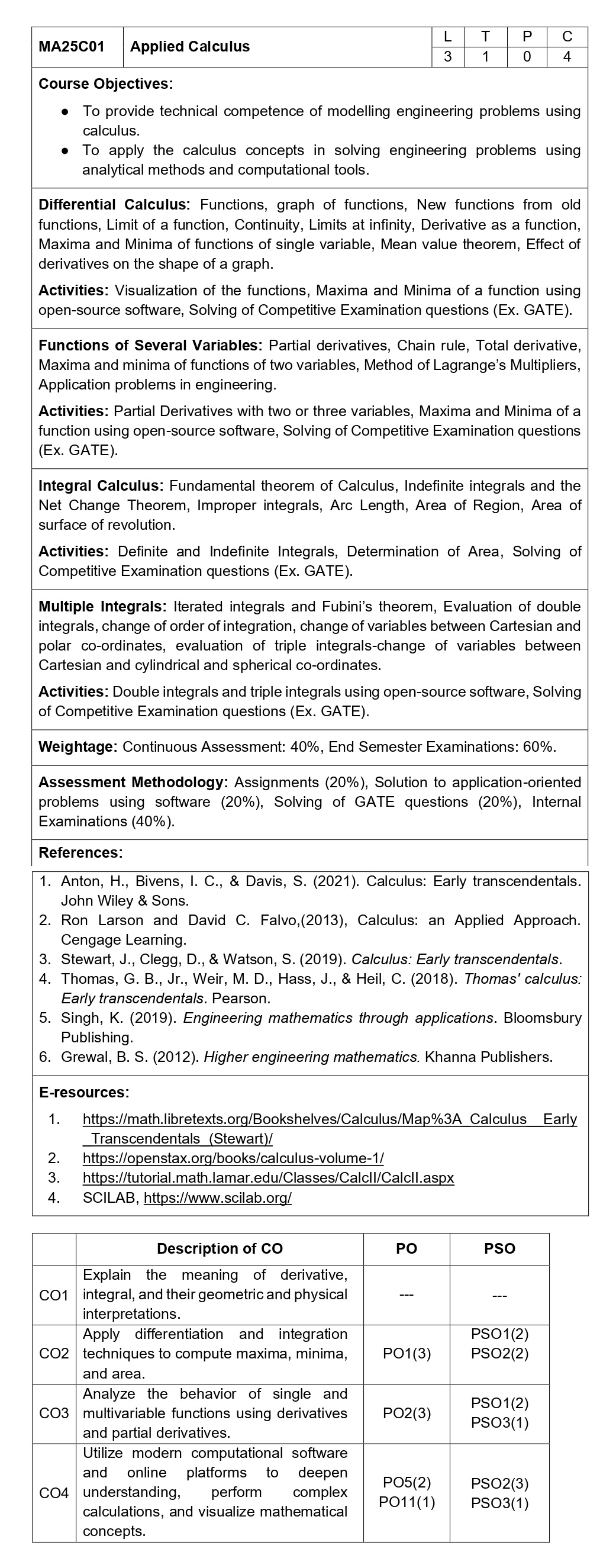
MA25C01
Applied Calculus
Course Objectives:
●
To provide technical competence of modelling engineering problems using
calculus.
●
To apply the calculus concepts in solving engineering problems using analytical
methods and computational tools.
Differential
Calculus: Functions, graph of functions, New
functions from old functions, Limit of a function, Continuity, Limits at
infinity, Derivative as a function, Maxima and Minima of functions of single
variable, Mean value theorem, Effect of derivatives on the shape of a graph.
Activities:
Visualization of the functions, Maxima and Minima of a function using
open-source software, Solving of Competitive Examination questions (Ex. GATE).
Functions
of Several Variables: Partial derivatives, Chain rule,
Total derivative, Maxima and minima of functions of two variables, Method of
Lagrange’s Multipliers, Application problems in engineering.
Activities:
Partial Derivatives with two or three variables, Maxima and Minima of a
function using open-source software, Solving of Competitive Examination
questions (Ex. GATE).
Integral
Calculus: Fundamental theorem of Calculus,
Indefinite integrals and the Net Change Theorem, Improper integrals, Arc
Length, Area of Region, Area of surface of revolution.
Activities:
Definite and Indefinite Integrals, Determination of Area, Solving of
Competitive Examination questions (Ex. GATE).
Multiple
Integrals: Iterated integrals and Fubini’s
theorem, Evaluation of double integrals, change of order of integration, change
of variables between Cartesian and polar co-ordinates, evaluation of triple
integrals-change of variables between Cartesian and cylindrical and spherical
co-ordinates.
Activities:
Double integrals and triple integrals using open-source software, Solving of
Competitive Examination questions (Ex. GATE).
Weightage:
Continuous Assessment: 40%, End Semester Examinations: 60%.
Assessment Methodology:
Assignments (20%), Solution to application-oriented problems using software
(20%), Solving of GATE questions (20%), Internal Examinations (40%).
References:
1.
Anton, H., Bivens, I. C., & Davis, S. (2021). Calculus: Early
transcendentals. John Wiley & Sons.
2.
Ron Larson and David C. Falvo,(2013), Calculus: an Applied Approach. Cengage
Learning.
3.
Stewart, J., Clegg, D., & Watson, S. (2019). Calculus: Early
transcendentals.
4.
Thomas, G. B., Jr., Weir, M. D., Hass, J., & Heil, C. (2018). Thomas'
calculus: Early transcendentals. Pearson.
5.
Singh, K. (2019). Engineering mathematics through applications. Bloomsbury
Publishing.
6.
Grewal, B. S. (2012). Higher engineering mathematics. Khanna Publishers.
E-resources:
1.
https://math.libretexts.org/Bookshelves/Calculus/Map%3A_Calculus Early_Transcendentals_(Stewart)/
2.
https://openstax.org/books/calculus-volume-1/
3.
https://tutorial.math.lamar.edu/Classes/CalcII/CalcII.aspx
4.
SCILAB, https://www.scilab.org/