Analog and Digital Communication - EC25C11
[ 4th Semester - ECE - Electronics and Communication Engineering Department ]
Under Class: | 4th Semester [ECE Dept Anna University 2025 Regulation] |
Analog and Digital Communication - EC25C11 - Study Materials, Notes, Important Questions, Anna University Semester Question Paper PDF Download
Engineering - Analog and Digital Communication - EC25C11 Subject (under Anna University 4th Semester - ECE - Electronics and Communication Engineering Department Regulation 2025) - Study Materials, Written and lecture Notes, Important Questions, Semester Question Paper PDF Download
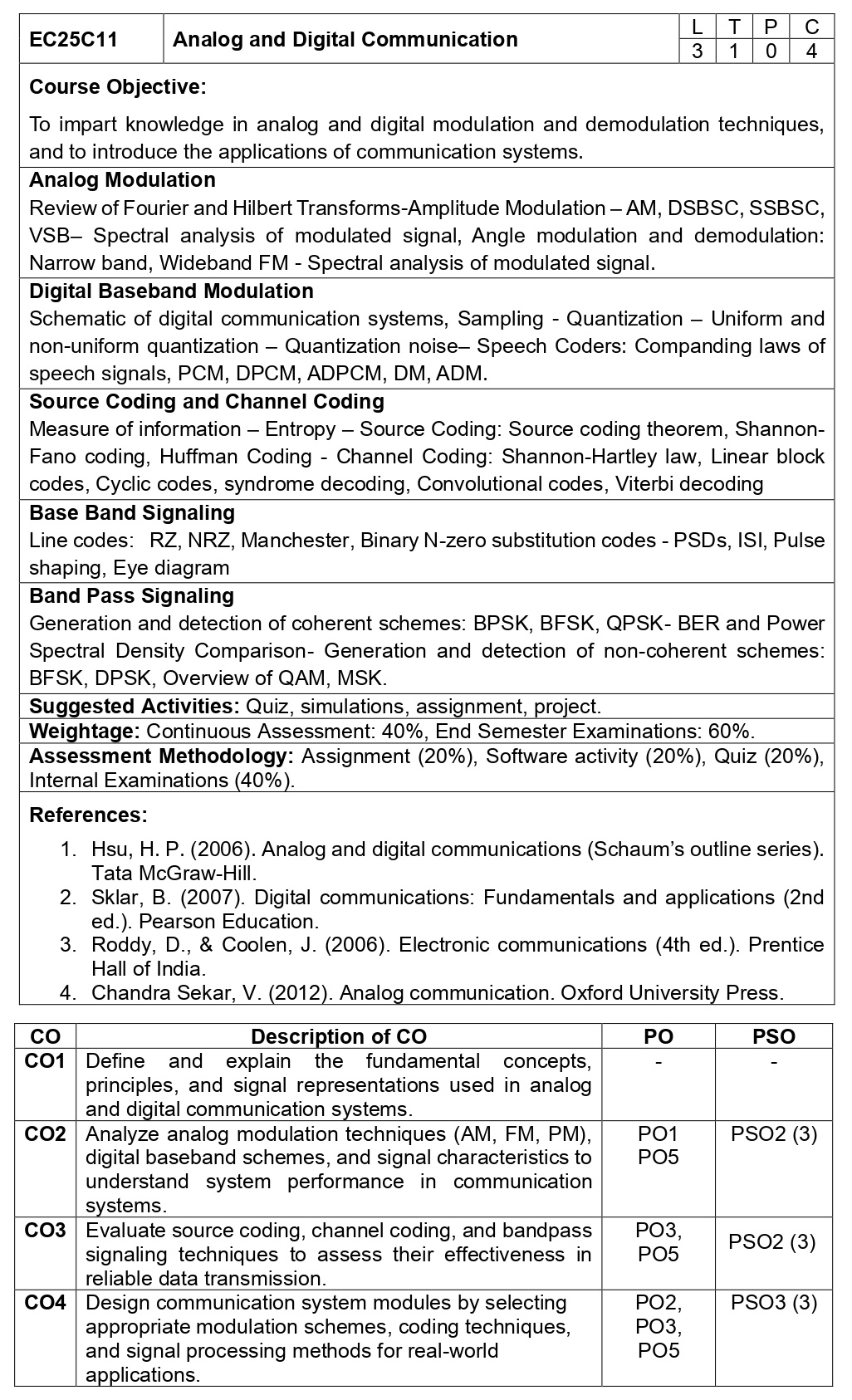
EC25C11:
Analog
and Digital Communication
Course
Objective:
To
impart knowledge in analog and digital modulation and demodulation techniques,
and to introduce the applications of communication systems.
Analog
Modulation
Review
of Fourier and Hilbert Transforms-Amplitude Modulation – AM, DSBSC, SSBSC, VSB–
Spectral analysis of modulated signal, Angle modulation and demodulation:
Narrow band, Wideband FM - Spectral analysis of modulated signal.
Digital
Baseband Modulation
Schematic of digital communication systems, Sampling - Quantization – Uniform and non-uniform quantization – Quantization noise– Speech Coders: Companding laws of speech signals, PCM, DPCM, ADPCM, DM, ADM.
Source
Coding and Channel Coding
Measure
of information – Entropy – Source Coding: Source coding theorem, Shannon-Fano
coding, Huffman Coding - Channel Coding: Shannon-Hartley law, Linear block
codes, Cyclic codes, syndrome decoding, Convolutional codes, Viterbi decoding
Base Band
Signaling
Line
codes: RZ, NRZ, Manchester, Binary N-zero substitution codes - PSDs, ISI, Pulse
shaping, Eye diagram
Band Pass
Signaling
Generation
and detection of coherent schemes: BPSK, BFSK, QPSK- BER and Power Spectral
Density Comparison- Generation and detection of non-coherent schemes: BFSK,
DPSK, Overview of QAM, MSK.
Suggested Activities:
Quiz, simulations, assignment, project.
Weightage:
Continuous Assessment: 40%, End Semester Examinations: 60%.
Assessment Methodology:
Assignment (20%), Software activity (20%), Quiz (20%),
Internal
Examinations (40%).
References:
1.
Hsu, H. P. (2006). Analog and digital communications (Schaum’s outline series).
Tata McGraw-Hill.
2.
Sklar, B. (2007). Digital communications: Fundamentals and applications (2nd
ed.). Pearson Education.
3.
Roddy, D., & Coolen, J. (2006). Electronic communications (4th ed.).
Prentice Hall of India.
4.
Chandra Sekar, V. (2012). Analog communication. Oxford University Press.